

1
/
из
4
OLYCOM
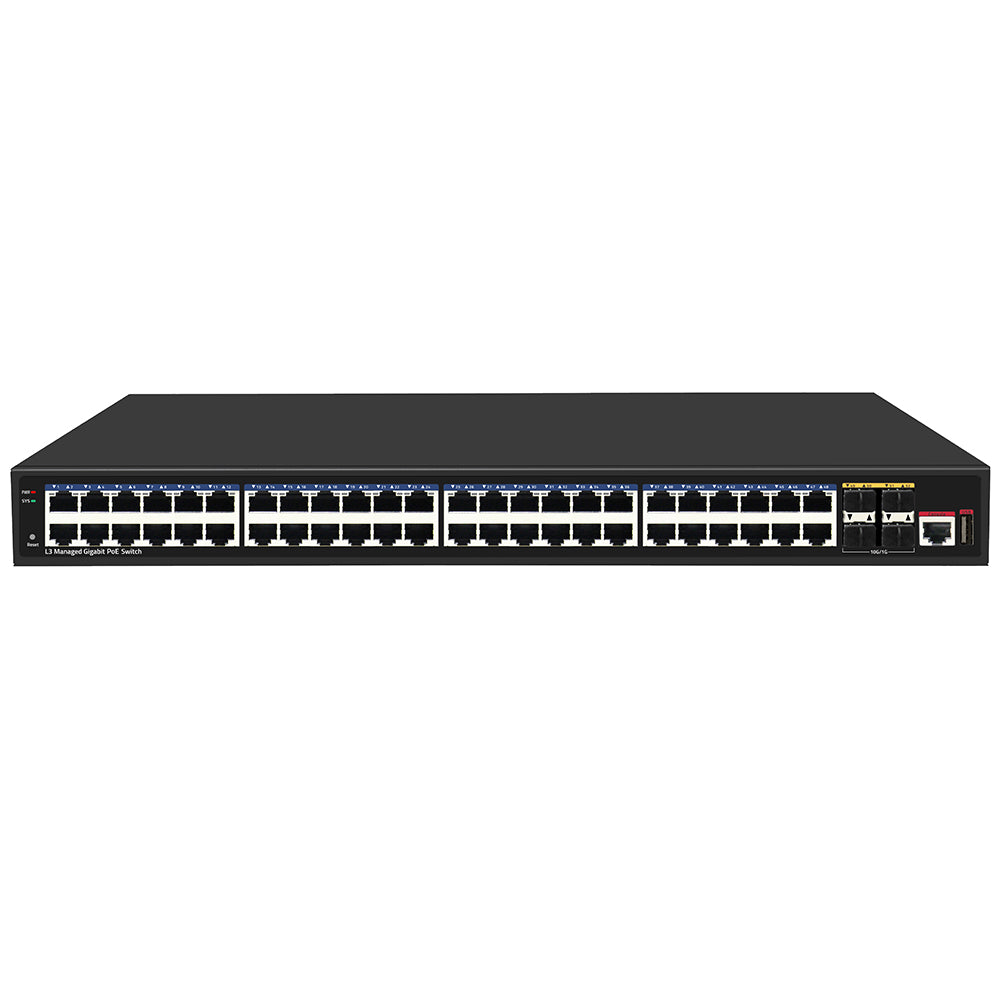
48-Port L3 Managed PoE++ Switch for Campus Core & Metro Aggregation, 4 × 10G SFP+ 400W, RIPv2/OSPF
48-Port L3 Managed PoE++ Switch for Campus Core & Metro Aggregation, 4 × 10G SFP+ 400W, RIPv2/OSPF
Обычная цена
$469.99 USD
Обычная цена
$499.99 USD
Цена со скидкой
$469.99 USD
Цена за единицу
/
за
Не удалось загрузить сведения о доступности самовывоза
Introduction
- The OM4X4848-PSE-GW is where the product line crosses from access-layer switching into core and aggregation territory.
- At 176Gbps backplane bandwidth, 131Mpps forwarding rate, 48 × Gigabit PoE ports with IEEE 802.3bt support up to 90W per port, 4 × 10G SFP+ uplinks, and a full L3 routing stack including OSPF v2 and RIPv1/v2, it operates at a scale and capability level that the 16-port and 20-port access switches in this lineup are not designed to reach.
- Three capabilities define what this switch is and who needs it.
- First, 90W PoE++ per port — the full IEEE 802.3bt ceiling — means it powers device categories that 802.3at switches categorically cannot: pan-tilt-zoom cameras with integrated heaters and high-torque motors, ceiling-mount LED luminaire systems, thin-client terminals with built-in displays, and high-output multi-radio Wi-Fi 6E access points drawing 60–90W.
- With a 400W total budget managed by intelligent per-port allocation and a PoE Watchdog that automatically recovers hung devices, it handles a mixed 802.3af/at/bt population without manual power budgeting. Second, L3 dynamic routing — OSPF v2 for large hierarchical campus networks and RIPv1/v2 for simpler routed environments — means the OM4X4848-PSE-GW can anchor the distribution or core layer in a campus three-tier architecture, performing inter-VLAN routing and participating in the routed network topology rather than depending on a separate router at every aggregation point.
- Third, 4 × 10G SFP+ uplinks provide the backbone bandwidth that 48 active Gigabit PoE ports generate in aggregate — when 48 devices are simultaneously active, 4 × 10G uplinks are not overspec; they are the correct design for non-blocking uplink aggregation at this access density.
Key Features
- 48 × 10/100/1000Mbps PoE + 4 × 10G SFP+ + Console + USB — Full Gigabit on every access port; 10G SFP+ uplinks support Direct Attach Copper (DAC) cables and 10G optical modules (SR/LR/ER) for flexible backbone connectivity; console and USB serial ports for out-of-band management and configuration transfer; 32K MAC address table for large campus topologies; 10KB jumbo frame support
- IEEE 802.3bt PoE++ — 90W Per Port, 400W Total Budget — The complete PoE power spectrum from a single platform: 15.4W (802.3af) / 30W (802.3at) / 60W / 90W (802.3bt) delivered to each port as the connected device requires; automatic PD classification and negotiation; 400W total budget with intelligent per-port power allocation that prioritizes higher-numbered or pre-designated critical ports when the aggregate approaches the ceiling
- Smart PoE Management:
- PoE Watchdog — per-port monitoring detects hung or unresponsive PDs; automatically power-cycles the port to recover the device without manual intervention; configurable detection interval and recovery behavior per port
- PoE Scheduling — time-based port power control; schedule APs, phones, and non-critical devices to power down outside operating hours; measurable energy reduction across a 48-port deployment running 24/7
- Per-Port Power Configuration — set maximum power budget per port to prevent a single high-draw device from consuming disproportionate budget; monitor real-time per-port power consumption through Web GUI and SNMP
- 176Gbps Non-Blocking Backplane / 131Mpps Forwarding Rate — The switching capacity to sustain wire-speed Gigabit forwarding across all 48 access ports plus four 10G uplinks simultaneously; 32Mbit buffer memory absorbs traffic bursts from high-density active device populations without dropping frames under peak load conditions
- Full L3 Routing Stack:
- OSPF v2 — link-state routing protocol for large hierarchical campus and enterprise networks; supports multi-area OSPF for scalable network segmentation; enables the OM4X4848-PSE-GW to participate as a distribution or core layer device in a fully routed campus topology
- RIPv1/v2 — distance-vector routing for simpler routed environments; backward compatibility with existing RIP-based infrastructure
- IPv4/IPv6 Static Routing — policy-based static routes for specific traffic engineering requirements
- DHCP Server / DHCP Relay — eliminates a separate DHCP server dependency at distribution layer; relay passes requests to centralized DHCP infrastructure across VLAN boundaries
- VLAN Interface Configuration — Layer 3 SVI (Switched Virtual Interface) on any VLAN for inter-VLAN routing without an external router
- ARP / Neighbor Discovery / IP Source Guard — complete Layer 3 address management and anti-spoofing at the distribution layer
- VLAN & L2 Feature Depth:
- 802.1Q Tag VLAN with Access / Trunk / Hybrid port modes; VLAN ID 1–4094; Voice VLAN, MAC VLAN, Surveillance VLAN
- STP / RSTP / MSTP with BPDU Guard, BPDU Filter, Root Guard, and TC Guard — loop protection across complex multi-switch topologies
- LACP dynamic and static link aggregation — bond 10G SFP+ uplinks for 20G or 40G effective backbone throughput; access port aggregation for server or NVR connections requiring >1G bandwidth
- Storm Control, Port Isolation, Loopback Detection, MAC Flapping Detection
- Security — Enterprise-Grade Defense:
- 802.1X port and MAC authentication with RADIUS and TACACS+ AAA; per-port and per-VLAN authentication policy
- DHCP Snooping with Option 82; Dynamic ARP Inspection; IP Source Guard — the standard anti-spoofing triad for enterprise access layers
- DoS attack protection on the control plane; management plane access control via ACL; SSHv2 and HTTPS for encrypted management sessions
- QoS — Eight Queues Per Port, Full Classification Stack:
- 802.1p CoS, DSCP, and ToS classification; WRR, SP, and hybrid WRR+SP scheduling
- Per-port ingress policing and egress shaping; prioritizes real-time voice and video over bulk data across a 48-port mixed-traffic access layer
- 802.3az Energy Efficient Ethernet on all ports — reduces power consumption on idle links across a 48-port chassis where partial port utilization is common outside peak hours
- Management & Operational Visibility:
- Web GUI, CLI, Telnet, SSHv2, SNMP v1/v2c/v3, RMON 1/2/3/9 for comprehensive historical traffic analysis
- LLDP / LLDP-MED — automatic discovery and provisioning of IP phones, APs, and PoE devices across all 48 ports
- System logs with remote Syslog; Ping, Traceroute, TDR copper cable test; SNTP; USB-based firmware backup and restore
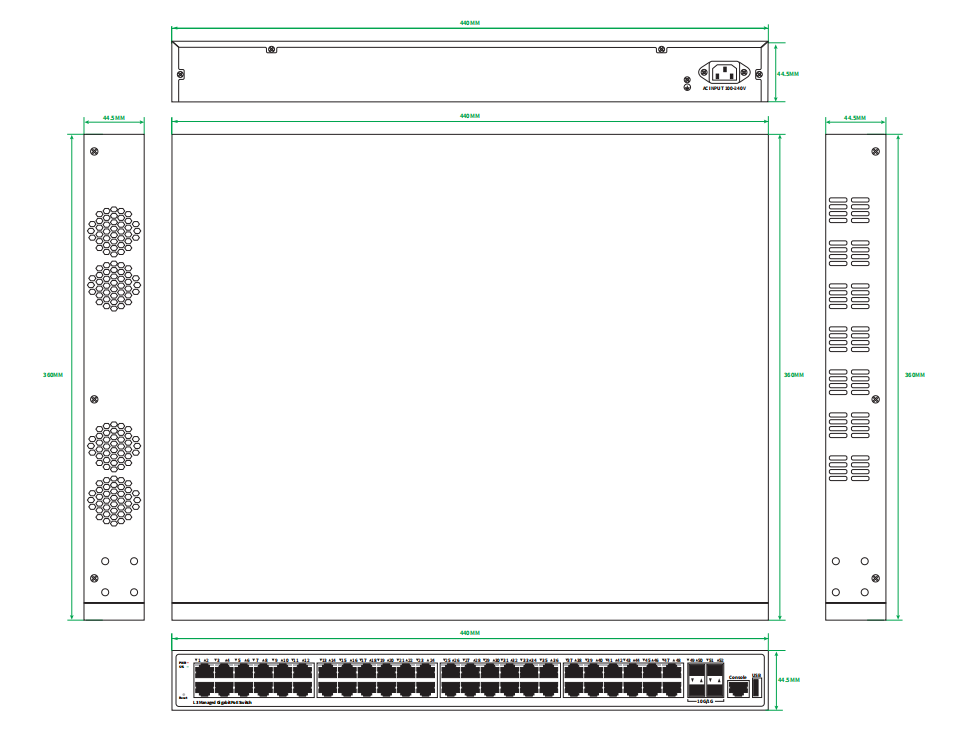
- 6KV Common-Mode Surge / ±8KV ESD / Fan-Cooled Metal Housing — Active cooling for sustained 400W PoE output at full 48-port load; surge and ESD protection on all copper ports; -10°C to +50°C operating temperature; CE / FCC / RoHS
Applications
- Campus Core & Distribution Layer — Three-Tier Architecture — In a standard campus three-tier network (core / distribution / access), the OM4X4848-PSE-GW operates at the distribution layer: 10G SFP+ uplinks connect to the core, 48 Gigabit PoE downlinks serve access-layer devices directly or aggregate downstream access switches, and OSPF v2 participation integrates the distribution layer into the campus routed topology. At medium-sized campuses where a dedicated separate core is not justified, the OM4X4848-PSE-GW serves as the collapsed core-distribution node — OSPF routing, inter-VLAN forwarding, LACP-bonded 10G uplinks to the WAN router or data center, and 48-port PoE access all from one chassis. MSTP with BPDU Guard maintains a loop-free topology regardless of how downstream access switches are connected
- Metro & Service Provider Aggregation — Telecom operators, cable TV providers, and municipal network operators deploying fiber-to-the-building (FTTB) or fiber-to-the-premises (FTTP) infrastructure use the OM4X4848-PSE-GW as the in-building or neighborhood aggregation switch: 4 × 10G uplinks connect to the metro fiber ring; 48 Gigabit ports serve subscriber equipment or downstream access switches; per-subscriber VLAN assignment enforces traffic isolation; IP Source Guard and Dynamic ARP Inspection prevent the subscriber-side spoofing attacks endemic in shared-infrastructure access networks; DHCP Snooping with Option 82 passes subscriber circuit identification to upstream AAA and provisioning systems; and OSPF v2 participation integrates the aggregation node into the service provider's routed infrastructure without static route management at every node
- High-Power PoE Surveillance & Smart Security Centers — Security operations centers for airports, seaports, government complexes, and industrial facilities combine high-power PTZ camera arrays with video management servers requiring >1G connectivity and NVR systems needing direct 10G access. The OM4X4848-PSE-GW powers 90W PTZ cameras with integrated heaters directly from its access ports, connects NVR and VMS servers through LACP-bonded Gigabit ports or direct 10G SFP+ connections, applies Surveillance VLAN to isolate camera traffic from management and user networks, and enables the PoE Watchdog to autonomously recover frozen cameras — a critical capability at facilities where manual camera reboot across dozens of remote mounting locations is operationally impractical
- Smart Building & IoT Infrastructure — Modern commercial buildings and industrial facilities combine a wider range of PoE device power profiles than any previous generation of building technology: standard 802.3af IP phones at 15.4W, 802.3at wireless APs at 30W, 802.3bt LED lighting systems and smart HVAC controllers at 60W, and 802.3bt thin-client display terminals at 90W. Only a switch that supports the full 802.3bt power spectrum can serve all of these device categories from the same access layer infrastructure. The OM4X4848-PSE-GW's intelligent per-port power allocation manages the mixed power profile without manual budget calculation; PoE Scheduling reduces building energy consumption during unoccupied hours; and the L3 routing capability integrates the building network into the enterprise WAN without a separate routing device in each building's IDF room
- Enterprise Unified Communications & High-Density Wireless — Large enterprise deployments running unified communications — voice, video conferencing, and collaboration platforms — across high-density Wi-Fi 6E infrastructure require the combination of QoS enforcement, PoE capacity, and uplink bandwidth that the OM4X4848-PSE-GW provides. Eight QoS queues per port with 802.1p and DSCP classification ensure voice packets receive strict priority forwarding across a 48-port mixed-traffic access layer; Voice VLAN automatically identifies and provisions IP phones; Wi-Fi 6E APs drawing 60–90W receive 802.3bt power from the same access ports that serve standard devices; LLDP-MED enables automatic per-device QoS and VLAN provisioning as phones and APs are connected; and LACP-bonded 10G uplinks ensure the backbone never becomes the congestion point when all 48 ports are simultaneously active at Gigabit speeds
Делиться