

1
/
из
4
OLYCOM
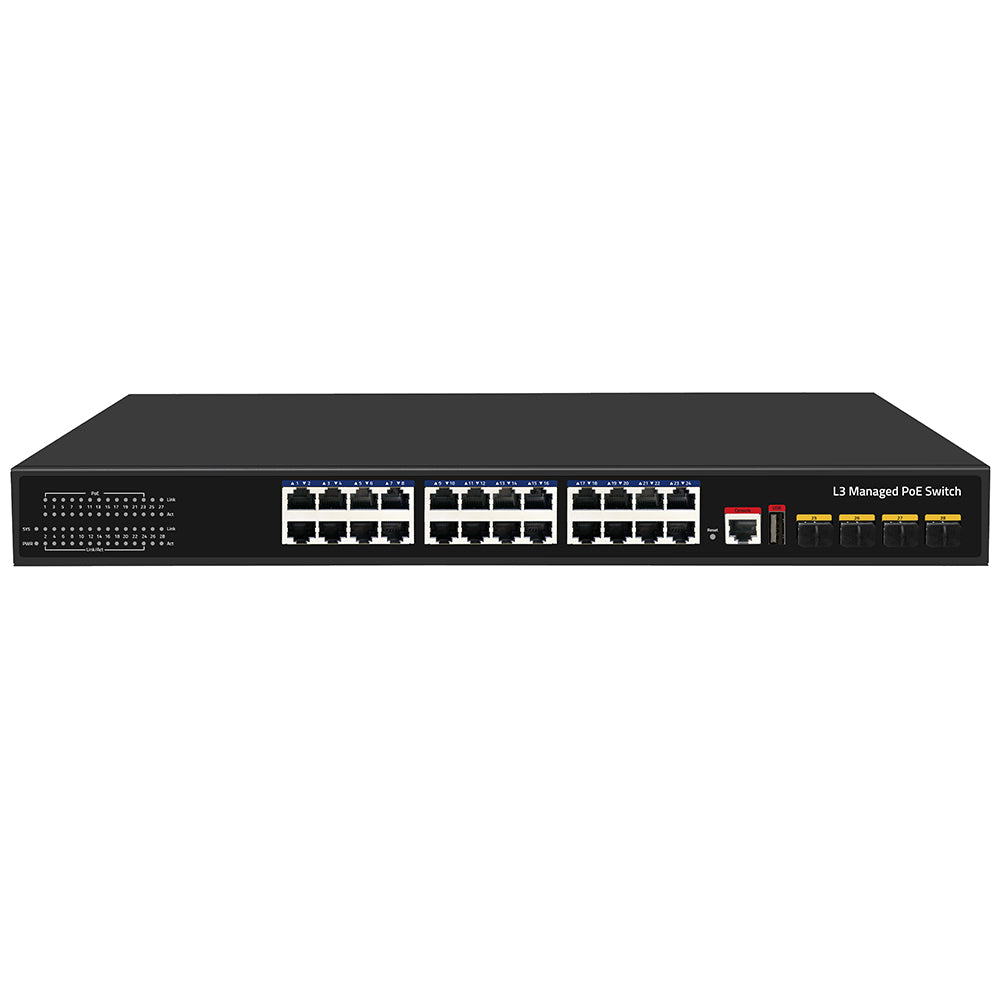
28 Port L3 Managed PoE Switch 10G Fiber Core Network 400W PoE Power Fanless
28 Port L3 Managed PoE Switch 10G Fiber Core Network 400W PoE Power Fanless
Обычная цена
$319.99 USD
Обычная цена
$339.99 USD
Цена со скидкой
$319.99 USD
Цена за единицу
/
за
Не удалось загрузить сведения о доступности самовывоза
Introduction
- The Olycom OM4X2424-PSE-GW occupies a different tier entirely from the access-layer PoE switches below it.
- As a 24-port Layer 3 managed PoE switch with 4 × 10G SFP+ uplinks, it is designed not merely to connect and power endpoints — but to route between them, prioritize their traffic, enforce security policy across them, and recover from topology failures in under 50 milliseconds, all while delivering a 390W PoE budget to a fully loaded mix of 802.3af and 802.3at devices.
- The 10G uplink tier is the architectural dividing line.
- Where Gigabit-uplink managed switches serve as access layer nodes feeding an upstream aggregation switch, the OM4X2424-PSE-GW’s 4 × 10G SFP+ ports give it the uplink bandwidth to function as the aggregation or distribution layer itself — collecting traffic from multiple downstream access switches across 10G fiber links, applying Layer 3 routing policy between VLANs, and forwarding to the core over a non-blocking 128Gbps fabric at 95.23Mpps.
- A 12Mbit packet buffer, 128MB DDR SDRAM, and 16MB flash give it the memory headroom for large routing tables, deep SNMP MIBs, and complex ACL rulesets that lower-tier platforms run out of headroom to support.
- Add OSPF v2 dynamic routing, ERPS ring protection with sub-50ms recovery, Surveillance VLAN, LLDP-MED, PoE watchdog with scheduling, and the full enterprise security stack — 802.1X, RADIUS, TACACS+, IP Source Guard, DAI, and DoS defense — and the OM4X2424-PSE-GW becomes the platform of choice wherever a network needs a single switch that can genuinely serve as its routing, security, and PoE distribution hub simultaneously.
Key Features
1 Interfaces & Physical
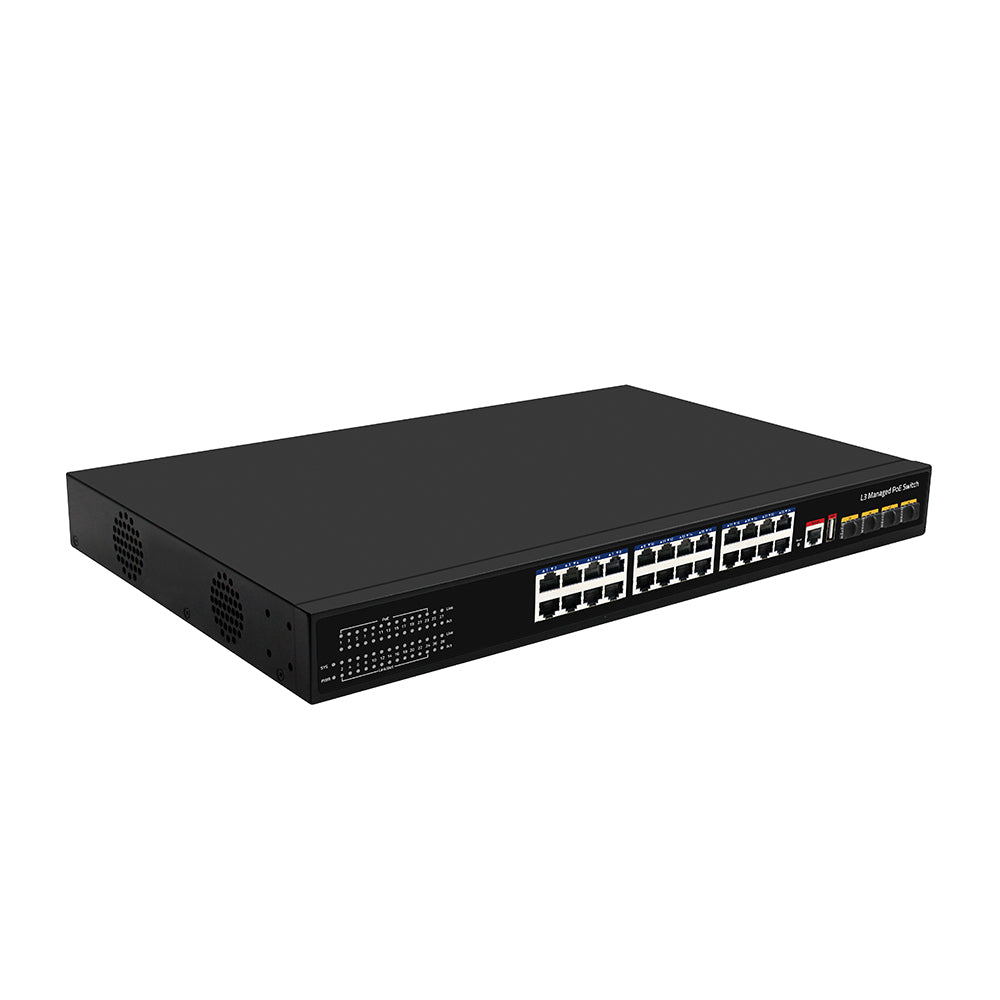
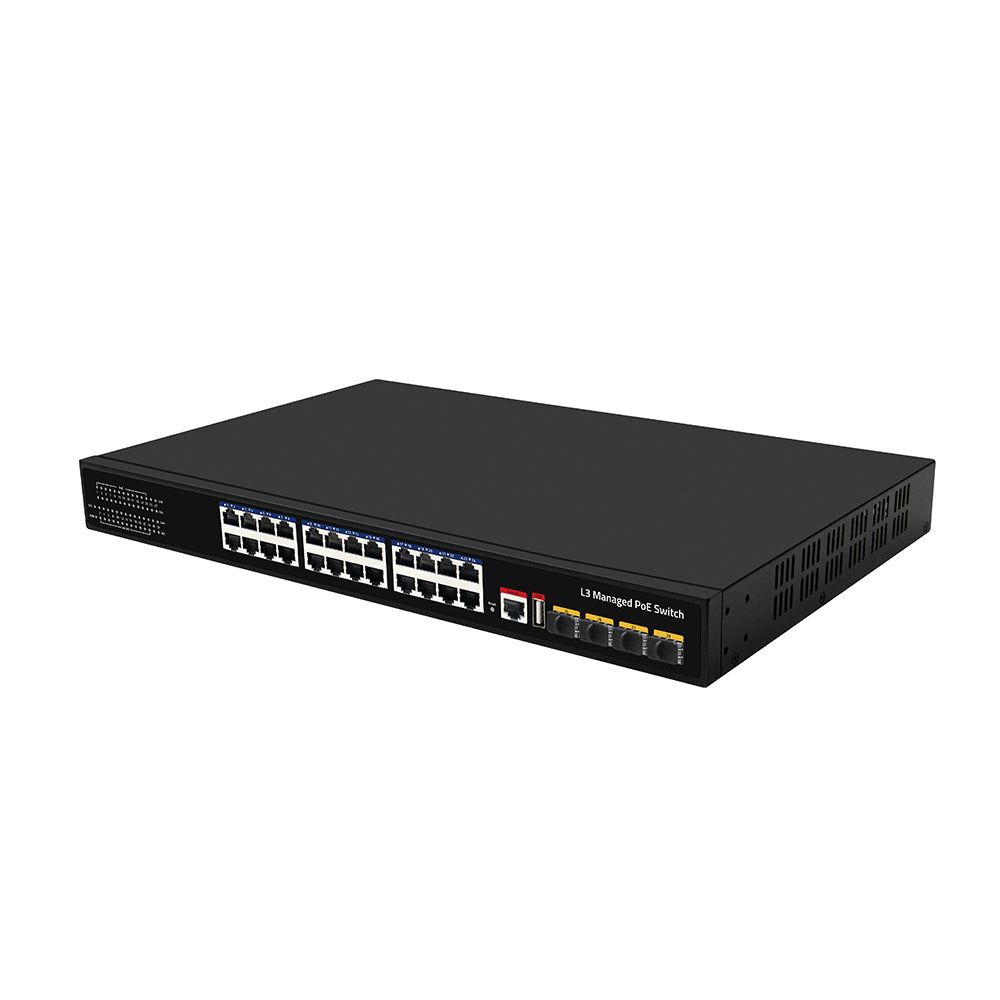
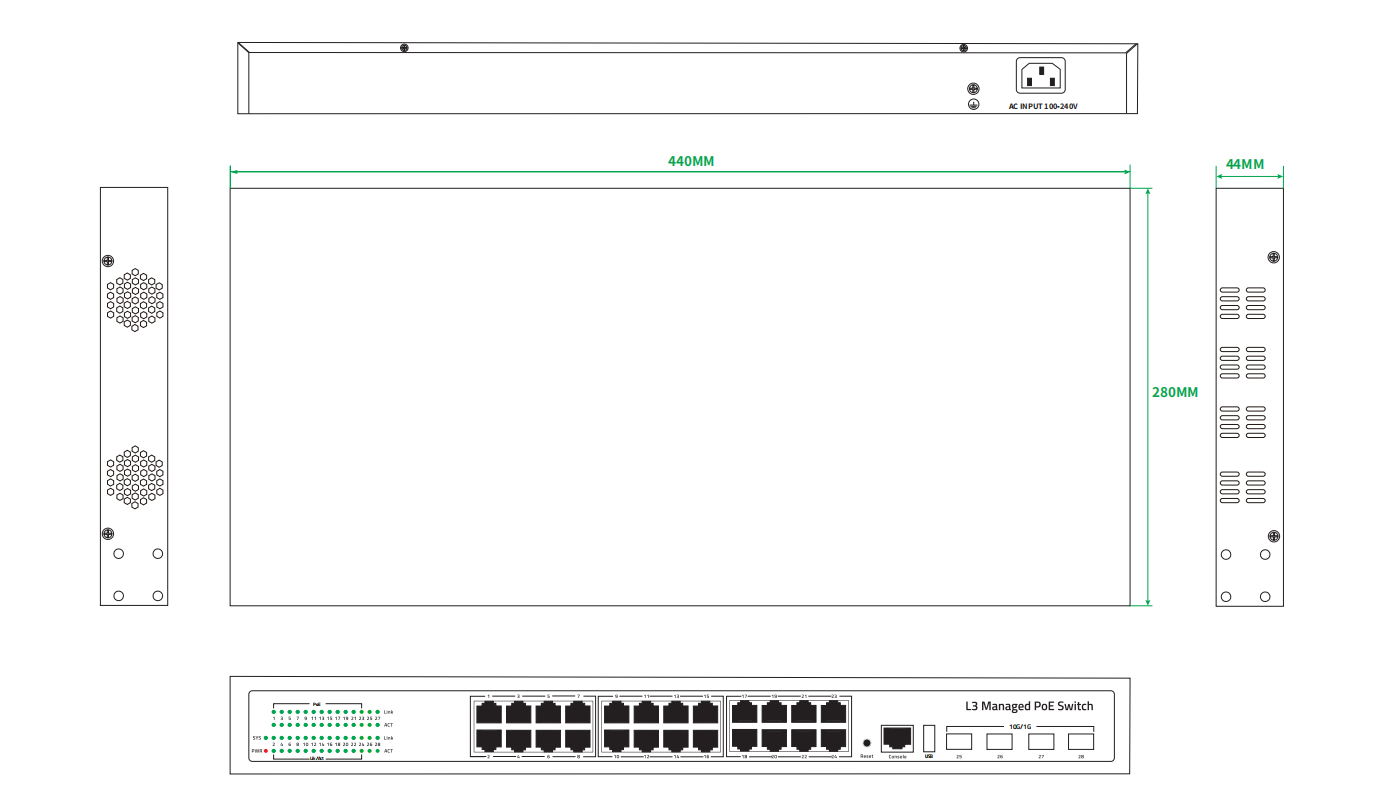
24 × 10/100/1000Mbps PoE Ports + 4 × 10G SFP+ Uplinks — 24 Gigabit access ports for PoE endpoints; four 10G SFP+ slots for high-speed uplinks to core switches, servers, or storage — the uplink density that enables aggregation-layer deployment
1 × RJ45 Console + 1 × USB Interface — Out-of-band console access for recovery and initial configuration; USB port for offline configuration backup, restore, and firmware upgrade independent of network connectivity
128Gbps Non-Blocking Switching Fabric / 95.23Mpps Forwarding Rate — Wire-speed performance across all 28 ports simultaneously; 12Mbit packet buffer, 128MB DDR SDRAM, 16MB flash; 10KB jumbo frame support for large video and storage payloads
2 PoE Power Management
390W Total PoE Budget — IEEE 802.3af/at — Among the highest PoE budgets in the 24-port managed class; supports a fully loaded mix of 802.3at (30W) endpoints across all 24 ports without throttling; intelligent PD detection per port; non-PoE devices protected automatically
PoE Watchdog with Auto Port Power-Cycle — Independently monitors each PoE endpoint via periodic ping; restarts any non-responding device automatically at the port level without affecting other ports or requiring management intervention — the operational feature that eliminates the majority of on-site service calls in deployed surveillance and AP networks
PoE Scheduling — Per-port time-based power control; defines daily or weekly on/off windows per endpoint; reduces energy consumption during low-occupancy periods and ensures devices power on before operating hours begin
Per-Port Power Monitoring — Real-time current, voltage, and wattage per PoE port; provides the granular consumption data needed for energy auditing, capacity planning, and early fault detection
3 Layer 2 Functions
VLAN Suite: 802.1Q, MAC, Protocol, Private, Voice, Surveillance VLAN — Surveillance VLAN automatically identifies IP camera traffic by OUI or protocol signature and assigns it to a dedicated VLAN without manual per-port configuration — critical for large camera deployments where manually assigning 24 ports to a surveillance VLAN is error-prone; Voice VLAN applies the same automatic logic to VoIP endpoints
QoS: 8 Hardware Queues / DSCP + 802.1p / WRR + Strict + SP+WRR Scheduling — Per-port 8-level hardware queuing with flexible scheduling modes; per-port ingress and egress bandwidth control; storm suppression for broadcast, multicast, and unknown unicast independently configurable per port
ERPS Ring Protection (ITU-T G.8032), <50ms Recovery — Sub-50ms ring failover across SFP+ uplinks; enables carrier-grade ring topologies between aggregation nodes; combined with MSTP for hybrid ring-and-tree environments
STP / RSTP / MSTP — Per-VLAN spanning tree instances under MSTP isolate topology changes to individual VLANs; a link failure in one VLAN’s spanning tree does not trigger reconvergence in others
LACP Link Aggregation (IEEE 802.3ad) — Static and dynamic bundling of 10G SFP+ uplinks for both combined throughput and path redundancy; a single uplink failure is transparent to the network
IGMP/MLD Snooping v1/v2/v3 + MVR — Multicast Video Registration (MVR) replicates IP video streams from a single source VLAN to subscriber VLANs without flooding; essential for IPTV, IP surveillance multicast, and campus-wide video distribution where uncontrolled multicast replication would saturate access ports
DHCP Server / Relay / Snooping / Option 82 — Full DHCP service stack; Option 82 relay agent inserts port and VLAN information into DHCP requests for subscriber identification in ISP and campus environments; Snooping builds the binding table that IP Source Guard and DAI rely on
4 Layer 3 Routing
OSPF v2 Dynamic Routing — Link-state routing protocol with automatic topology discovery and sub-second convergence; scales to complex multi-switch campus and metro topologies without manual static route maintenance; route redistribution between OSPF and static routes for hybrid environments
RIP v1/v2 — Distance-vector routing for simpler multi-subnet environments where OSPF overhead is unnecessary
IPv4/IPv6 Static Routing + Dual-Stack Management — Full dual-stack operation; static routes for policy-controlled inter-VLAN traffic; IPv6 management via SSH, SNMP, HTTP/HTTPS, NTP, TFTP, ACL, and QoS
5 Security
802.1X Port Authentication + RADIUS + TACACS+ + AAA — Every port requires device authentication before network access is granted; RADIUS assigns authenticated devices to their correct VLAN automatically; TACACS+ separates authentication from authorization and accounting for switch management access; AAA provides the audit trail that compliance frameworks require
ACL: MAC, IPv4, IPv6 — Ingress & Egress — Hardware-accelerated access control at line rate; both directions per port; supports time-based ACL activation for scheduled policy enforcement
IP Source Guard + Dynamic ARP Inspection (DAI) — IP Source Guard validates every packet’s source IP against the DHCP Snooping binding table, dropping spoofed addresses at hardware speed; DAI validates ARP packets against the same table, preventing ARP cache poisoning and man-in-the-middle attacks on any VLAN
DoS Defense — Hardware-rate-limits protocol-specific attack traffic — SYN floods, ICMP floods, and malformed packet attacks — before they consume CPU cycles or disrupt legitimate traffic
6 Management
Web GUI, SSHv2, Telnet, CLI, SNMP v1/v2c/v3, RMON, LLDP/LLDP-MED — Full enterprise management stack; LLDP-MED automatically discovers VoIP phones, APs, and cameras, applies the correct VLAN and QoS policy, and reports device inventory to the NMS; HTTPS and SSHv2 encrypt all management sessions; RMON provides remote traffic statistics without per-port SPAN sessions
USB Configuration Backup / Restore / Firmware Upgrade — Offline configuration management independent of network connectivity; a USB stick carries the entire switch configuration for rapid replacement deployment
Applications
- Campus Distribution & Aggregation Layer — The 4 × 10G SFP+ uplinks define the OM4X2424-PSE-GW’s role in a campus hierarchy: it sits between access-layer switches and the core, collecting Gigabit uplinks from multiple access switches over 10G fiber and forwarding aggregated traffic to the core at wire speed. OSPF v2 dynamic routing between VLANs eliminates the need for a dedicated router, ERPS ring protection on the 10G uplinks provides sub-50ms recovery if any inter-switch link fails, and LACP bonds redundant uplinks for combined throughput. A single OM4X2424-PSE-GW replaces what would otherwise require a separate Layer 3 router plus an aggregation switch at each distribution point
- Enterprise PoE Distribution with Security Enforcement — In enterprise environments where endpoint security is a compliance requirement, the OM4X2424-PSE-GW enforces 802.1X authentication on every port: a VoIP phone authenticates, gets placed in the Voice VLAN automatically, and receives 802.1p-marked QoS priority; an AP authenticates, receives its management VLAN assignment and 802.3at power; an unknown device is blocked at the port level before it sees any network traffic. IP Source Guard and DAI run silently on every port, blocking spoofed traffic that would otherwise bypass VLAN boundaries. The 390W budget powers all 24 endpoints simultaneously without priority throttling
- Metropolitan & ISP Aggregation Nodes — At ISP distribution points serving a multi-building or multi-block subscriber base, the OM4X2424-PSE-GW aggregates subscriber traffic from downstream access switches via 10G uplinks, applies DHCP Option 82 to tag each subscriber’s requests with their port and VLAN identity for upstream RADIUS billing, and enforces per-subscriber bandwidth limits through QoS ingress policing. MVR replicates IPTV multicast streams to subscriber VLANs without flooding the access network, and ERPS ring protection on the 10G uplink ring prevents a single fiber cut from taking down an entire subscriber segment
- Smart Campus & University Core Networks — A university building served by the OM4X2424-PSE-GW as its distribution switch gets OSPF-routed inter-VLAN connectivity between student, faculty, administrative, IoT, and guest networks — with ACL policy enforcing which VLANs can initiate connections to which others, and RADIUS-integrated 802.1X ensuring that every device connecting to any port is authenticated before receiving its VLAN assignment. Surveillance VLAN automatically categorizes IP cameras by OUI signature without requiring IT staff to manually configure camera ports, and PoE watchdog self-heals frozen cameras and APs without generating a helpdesk ticket
- Smart City & Government Infrastructure Hubs — At city-level network distribution points connecting traffic cameras, public Wi-Fi, environmental sensors, emergency communications, and administrative systems, the OM4X2424-PSE-GW provides the routing separation, security enforcement, and operational visibility that government network security policies mandate. TACACS+ separates management authentication from network authentication with full per-command accounting, SSHv2 encrypts every management session, SNMP v3 with authentication and privacy integrates with government-grade NMS platforms, and the USB interface allows configuration backup and firmware management without network access — critical during security incidents when management network access may be restricted
- Video Surveillance Command & Distribution Nodes — In large-scale IP surveillance deployments — city CCTV networks, airport security, hospital campus surveillance — the OM4X2424-PSE-GW serves as the distribution node collecting streams from multiple downstream access switches and forwarding to the video management platform. IGMP Snooping with MVR ensures multicast camera streams are delivered only to authorized monitoring stations without flooding the network, QoS strict-priority queuing guarantees live monitoring traffic is never preempted by recording traffic, and PoE watchdog keeps all 24 access-layer camera switches self-healing without operations center intervention
- Data Center Edge & Server Access — The four 10G SFP+ ports connect directly to servers, NAS arrays, and hypervisor hosts requiring 10G access, while the 24 Gigabit PoE ports serve out-of-band management interfaces, IP KVM switches, and infrastructure devices — consolidating server access and infrastructure management onto a single switch. Static routing between server VLANs and management VLANs provides controlled connectivity without a dedicated firewall at the access layer, and LACP-bonded 10G uplinks to the core ensure server traffic has redundant, high-bandwidth paths
Делиться