

1
/
из
5
OLYCOM
Olycom 10G Managed Industrial PoE Switch, SFP+ Fiber Backbone, Optical Bypass, 240W, DIN Rail
Olycom 10G Managed Industrial PoE Switch, SFP+ Fiber Backbone, Optical Bypass, 240W, DIN Rail
Обычная цена
$209.99 USD
Обычная цена
$229.99 USD
Цена со скидкой
$209.99 USD
Цена за единицу
/
за
Не удалось загрузить сведения о доступности самовывоза
Introduction
- There is a clear boundary in industrial network architecture between switches that connect field devices and switches that form the backbone those connections depend on.
- The Olycom IM-FP4X88GW sits firmly on the backbone side of that boundary — a fully managed industrial PoE fiber switch combining 4 × 10G SFP+ fiber uplinks with 8 × Gigabit PoE RJ45 access ports, designed to function as the aggregation and backbone node in demanding industrial, transportation, and infrastructure networks where commercial-grade managed switches are neither certified nor rated to operate.
- What separates the IM-FP4X88GW from the managed switches that precede it in this lineup is the simultaneous presence of three capabilities that industrial backbone nodes require and that most platforms compromise on at least one of: 10G fiber uplink density for high-bandwidth ring and aggregation topologies; -40°C to +75°C certified operation for permanent deployment without climate control; and a complete enterprise-grade software stack — OSPF, VRRP, ERPS <50ms ring protection, MSTP, LACP, full ACL/802.1X/RADIUS/TACACS+ security, IGMP Snooping v3, Modbus/TCP, NQA, and SNMP v1/v2c/v3 — that gives network engineers the same operational control over a field-mounted industrial switch that they expect from a data center platform.
- The 176Gbps non-blocking fabric, 4GB DRAM, 12Mbit packet buffer, 95.23Mpps forwarding rate, and 12KB jumbo frame support provide the processing headroom for large routing tables, deep security policy rulesets, and high-throughput video and SCADA traffic simultaneously — without the memory contention that smaller managed platforms encounter when multiple advanced features are enabled concurrently.
- An optional optical bypass protection module ensures fiber continuity through the switch even during a complete power failure — a capability that no software feature can replicate and that critical ring topologies cannot do without.
Key Features
1 Hardware Platform
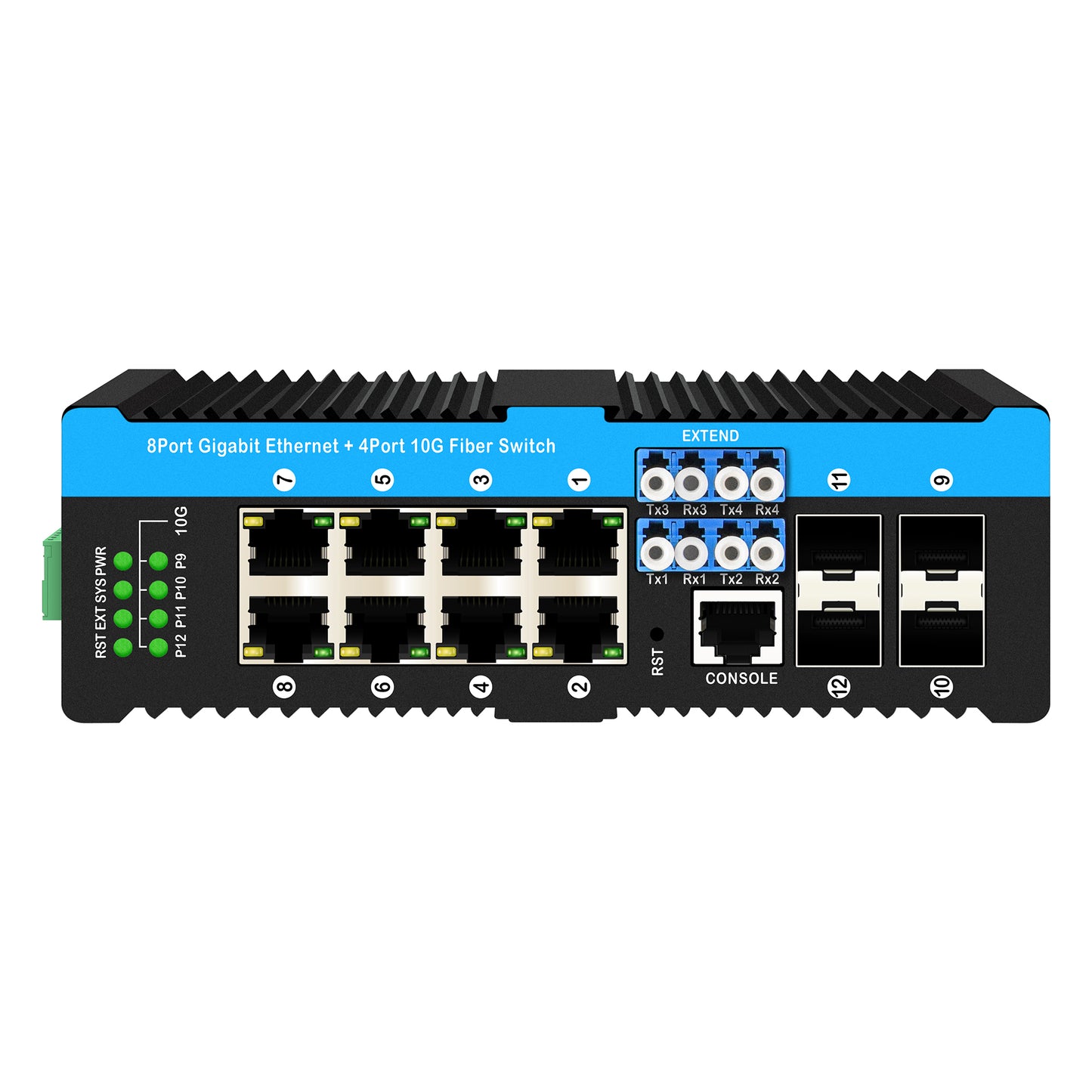
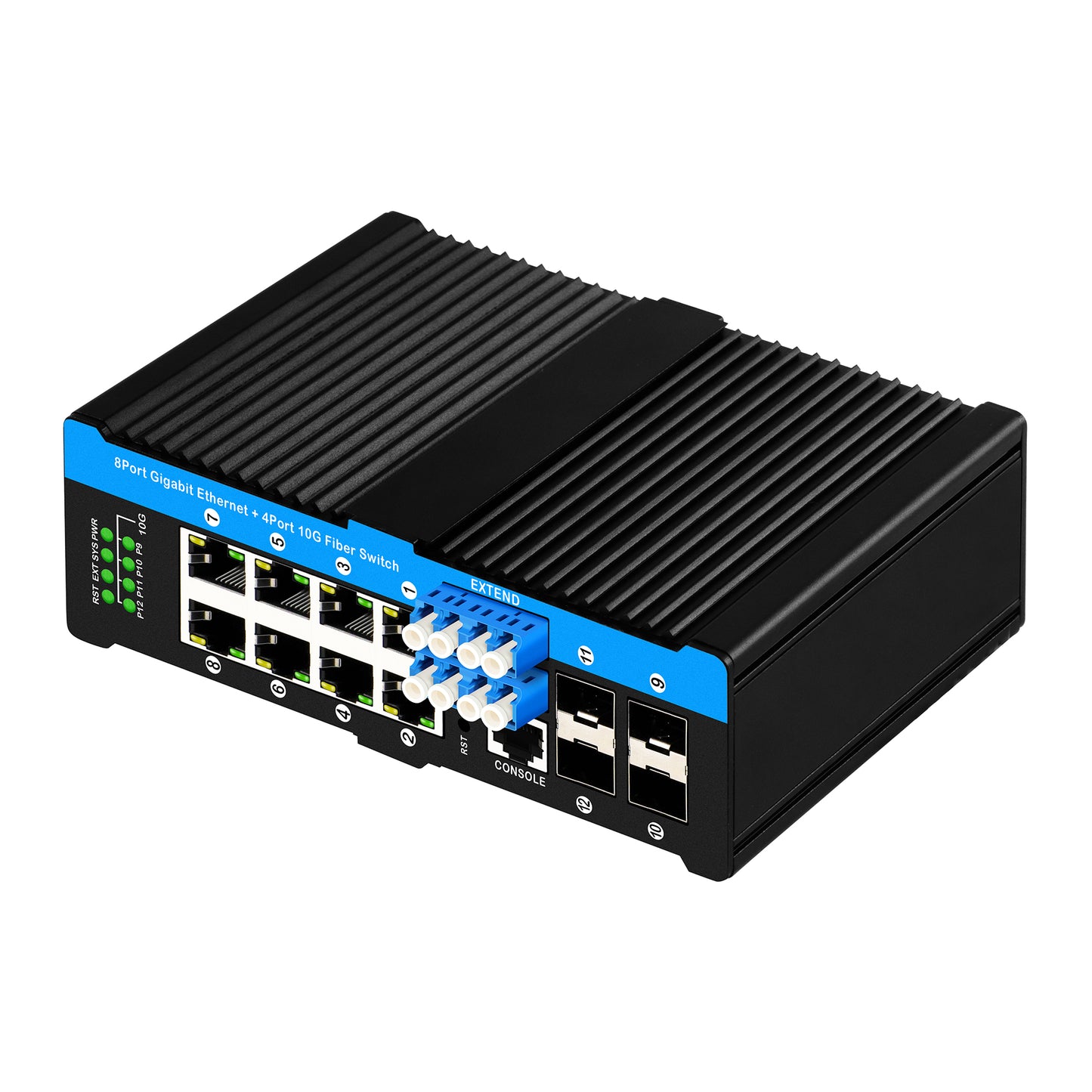
4 × 10GBase-FX SFP+ Fiber Ports — Full 10G fiber uplink density for backbone ring participation, high-bandwidth aggregation, and inter-node connectivity; single-mode support from 20km to 120km (1310/1550nm; 1490/1550nm); multimode to 2km (1310nm); hot-swappable SFP+ modules
8 × 10/100/1000Mbps PoE RJ45 Ports — Full Gigabit auto-sensing on all access ports; IEEE 802.3af (15.4W) and 802.3at (30W) per port; per-port auto-detection of PoE vs. non-PoE; Auto MDI/MDIX; 6KV Ethernet surge protection on all copper interfaces
1 × Console RJ45 — Out-of-band Cisco-style CLI access for recovery, initial configuration, and diagnostics independent of network connectivity
176Gbps Non-Blocking Switching Fabric / 95.23Mpps Forwarding Rate — Wire-speed forwarding across all 12 ports simultaneously; 4GB DDR DRAM, 12Mbit packet buffer, 12K L2 MAC table, 12KB jumbo frame; <10µs forwarding delay; store-and-forward architecture
Optional BYPASS Optical Bypass Protection — Hardware-level fiber continuity through the switch chassis during power loss or system failure; the fiber ring remains intact even if the switch loses power — a critical requirement for ring topologies where a switch failure must not break the physical light path
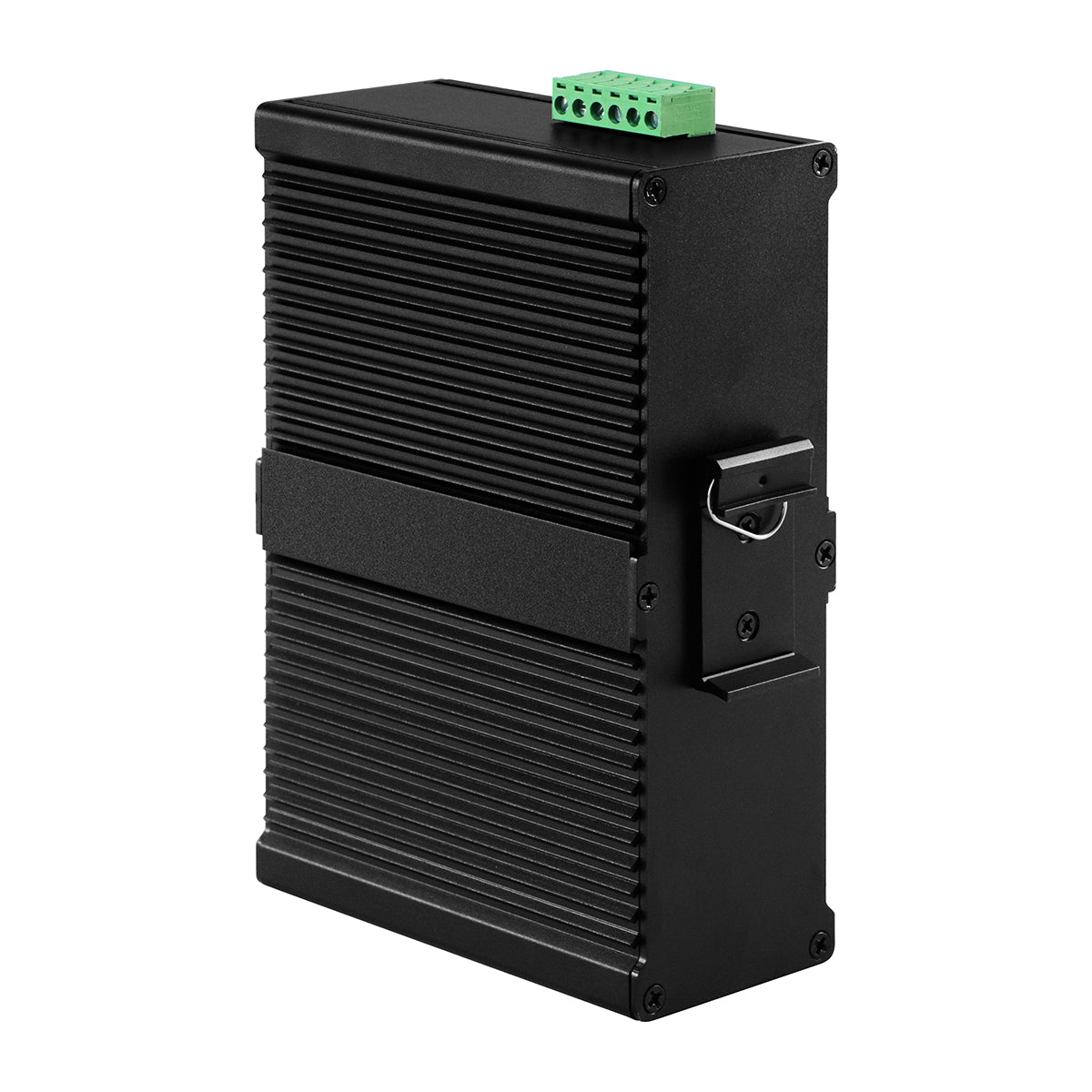
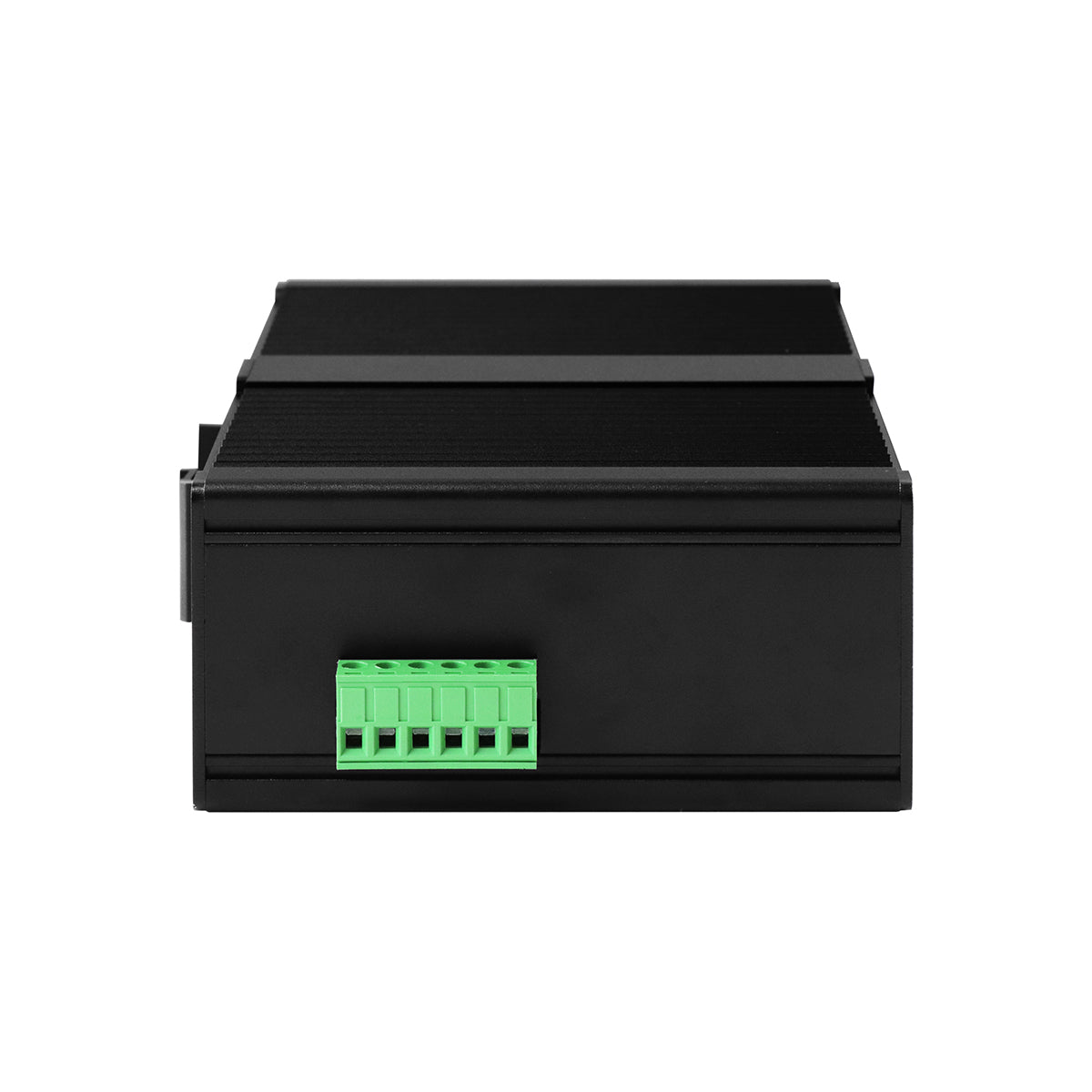
DC 12–52V Wide-Range Redundant Power Input — Removable terminal block; accepts 12V, 24V, or 48V DC from any industrial power source; reverse polarity protection and overload current protection standard; 8W no-load / 18W full-load consumption; CPU watchdog for automatic system recovery from software faults
-40°C to +75°C Operating Temperature — Cold-start rated at -40°C without warm-up; full specification performance at +75°C without derating; storage to +85°C; 0–95% RH non-condensing
165 × 112 × 54mm IP40 Corrugated Metal Housing, 0.85kg — DIN-rail mount; compact enough for tight automation cabinets and field enclosures; CE Class B / FCC Class B / EN IEC 62368-1 certified
2 Redundancy & Topology
ITU-T G.8032 ERPS — Sub-50ms Ring Recovery — Hardware-assisted Ethernet Ring Protection Switching with <50ms failover; supports single ring, sub-ring, and multiple interconnected ring topologies — the topological flexibility that large industrial sites and metropolitan networks require from a single switch platform
STP / RSTP / MSTP — Full spanning tree suite; MSTP maps independent VLAN groups to separate spanning tree instances; a topology change in one instance does not trigger reconvergence in others; BPDU Guard and Root Guard per port
VRRP (Virtual Router Redundancy Protocol) — Provides gateway redundancy between two IM-FP4X88GW switches acting as master and backup default gateways; if the master fails, the backup assumes the virtual IP address within seconds — transparent to all connected endpoints
Static & Dynamic LACP Link Aggregation (IEEE 802.3ad) — Up to 5 trunk groups; bonds multiple 10G SFP+ ports for combined throughput and path redundancy; hash-based load distribution across SA, DA, IP, and TCP/UDP port
3 Layer 2 & QoS
VLAN: IEEE 802.1Q (4094 VIDs), MAC-Based (256 entries), IP Subnet-Based (128 entries), Protocol-Based (128 entries), QinQ (802.1ad), GVRP, MVR — The most comprehensive VLAN suite in the IM industrial series; GVRP dynamically propagates VLAN membership across the ring without manual per-switch configuration; MVR replicates multicast video streams from a source VLAN to subscriber VLANs without flooding
QoS: 8 Hardware Queues / IEEE 802.1p + IP Precedence + DSCP / QCL/QCE Classification — QoS Control Lists classify traffic by frame type, source/destination MAC, VLAN ID, PCP, DEI, protocol, source IP, IP fragment, DSCP, and TCP/UDP port number — the granularity needed to correctly mark and queue heterogeneous industrial traffic (SCADA, video, VoIP, and data) on the same physical infrastructure
IGMP/MLD Snooping v1/v2/v3 — Up to 1022 multicast group entries; per-port filtering profiles; throttling and fast leave; static router port configuration; MLD Snooping v1/v2 extends group management to IPv6 multicast environments
Loop Protection, Storm Control (Unicast / Broadcast / Multicast) — Independent per-type storm control thresholds; loop protection detects and disables loops not covered by STP convergence windows
IEEE 802.3az EEE (Energy Efficient Ethernet) — Dynamically reduces power on idle ports and adjusts power for short cable lengths; LED intensity management for additional energy savings in always-on deployments
4 Layer 3 Routing
OSPF v2, RIP v1/v2, Static Routes, VRRP — Full dynamic routing suite; OSPF provides topology-aware convergence in complex multi-switch industrial networks; VRRP provides gateway redundancy between paired switches; static routes for deterministic policy-controlled paths
IPv4/IPv6 Dual-Stack — Full dual-stack management; IPv6 Telnet, SSH, SNMP, HTTP, NTP, TFTP, QoS, and ACL; ICMPv6 support; NDP management
DHCP Server / Client / Relay / Snooping / Option 82 — Complete DHCP service stack; Option 82 relay agent information for subscriber identification in aggregation environments
5 Security
IEEE 802.1X — Port-Based & MAC-Based Authentication — Every port requires device authentication before network access; MAC-based 802.1X authenticates individual devices on shared ports without per-port lockdown
RADIUS / TACACS+ 3.0 — Authentication & Accounting — RADIUS for network device authentication with VLAN assignment; TACACS+ 3.0 for switch management access with per-command authorization and full accounting trail
ACL: L2/L3/L4 — Up to 256 Rules, IPv4 & IPv6 — Hardware-accelerated line-rate ACL; L2 (MAC SA/DA/VLAN), L3 (IP SA/DA/Subnet), L4 (TCP/UDP port); both IPv4 and IPv6 ACL rulesets; supports ingress and egress application
IP Source Guard — Validates every packet’s source IP against the DHCP Snooping binding table; drops spoofed addresses at hardware speed before they reach the routing layer
HTTPS / SSH v2 / SSL — All remote management sessions encrypted; management interface access filtering per method (Web, Telnet/SSH, CLI, console)
DDoS Defense & System Automatic Defense — Rate-limits protocol-specific attack traffic before CPU exhaustion; CPU watchdog provides automatic system recovery from software deadlocks
6 Industrial & Operational Management
Modbus/TCP Support — Native Modbus/TCP management and monitoring integration; allows the switch to be addressed and monitored by industrial SCADA systems and PLCs using the same protocol used for field device management — eliminating the need for a separate OPC bridge or protocol converter in OT/IT converged environments
NQA (Network Quality Analysis) — Active probing to measure round-trip delay, jitter, and packet loss to specific network nodes; provides quantitative link quality data for SLA verification, troubleshooting, and capacity planning without external test equipment
Cable Diagnostic (TDR) — Measures UTP cable integrity and locates fault or break points from the switch CLI without external test equipment; reports cable length for installed run verification
SNMP v1/v2c/v3, RMON I & II, MIB II + Private MIB — Full SNMP management stack; RMON I for traffic statistics, RMON II for application-layer visibility; Private MIB for platform-specific monitoring; UPnP for automatic network discovery
LLDP / LLDP-MED (IEEE 802.1ab) — Automatic neighbor discovery and topology mapping; LLDP-MED pushes network policy to VoIP and camera endpoints automatically
Syslog (RFC3164), Email Alerts, Alarm Relay Output — Three-channel event notification: Syslog to centralized log server, email to operations team, and hardware alarm relay for integration with physical alarm panels and SCADA alarm systems
TFTP/HTTP Firmware Upgrade with Redundant Firmware — Failed upgrade automatically activates the previous firmware image; zero-risk production updates
Cisco-Style CLI, Web GUI, Telnet, Windows Utility, SNMP Management — Full management method coverage; Cisco-style CLI reduces retraining for engineers familiar with enterprise networking
Applications
- Industrial Backbone Ring Nodes with 10G Aggregation — Four 10G SFP+ ports define the IM-FP4X88GW’s primary role: the backbone node in an industrial fiber ring where each switch participates in one or more ERPS-protected 10G rings while simultaneously serving a local cluster of PoE field devices through its eight Gigabit access ports. OSPF v2 handles inter-VLAN routing between the OT and IT domains traversing the ring; VRRP provides gateway redundancy between paired IM-FP4X88GW nodes at critical backbone junctions; ERPS delivers <50ms ring recovery when any fiber segment fails. This is the switch for industrial networks that have exceeded what Gigabit-uplink managed switches can architect
- OT/IT Convergence Boundary Enforcement — In manufacturing environments where operational technology (PLCs, SCADA, motion controllers) and corporate IT (ERP servers, engineering workstations, Wi-Fi) share physical infrastructure, the IM-FP4X88GW enforces the boundary: ACL policy controls which OT subnets can initiate connections to IT resources and vice versa; 802.1X with RADIUS prevents unauthorized devices from connecting to any port; IP Source Guard blocks address spoofing across the boundary; and Modbus/TCP integration allows the switch itself to be monitored by the OT management system using the same tools used for every other field device — no additional management protocol required
- Power Substation & Grid Automation Networks — ERPS sub-50ms ring recovery meets the protection system timing requirements of IEC 61850 substation automation networks; VRRP provides gateway redundancy between redundant substation LAN nodes; OSPF routes between protection, monitoring, and administrative VLANs; and the optional BYPASS module ensures the fiber ring remains optically continuous even during a complete switch power loss — a requirement that substation network designers cannot achieve with software redundancy alone. The -40°C cold-start rating covers outdoor-adjacent relay panels in cold climates
- Railway Interlocking & Signaling Networks — EN-environment railway signaling and interlocking networks require deterministic failover times, hardware-level redundancy, and management protocols compatible with railway SCADA systems. ERPS <50ms, hardware BYPASS, Modbus/TCP, SNMP v3, and Syslog alarm relay output collectively satisfy these requirements from a single DIN-rail-mounted platform rated for the railway operating environment. The 10G uplinks handle the aggregated bandwidth of interlocking, CCTV, PIS, and communications traffic on a shared infrastructure backbone
- Oil & Gas Offshore & Remote Automation — Offshore platforms and remote pipeline facilities operate in environments where -40°C nights, high-humidity salt atmospheres, and powerful motor-drive interference coexist with the requirement for zero-downtime network operation. The IM-FP4X88GW’s IP40 corrugated metal housing, wide temperature rating, full EMS immunity, and BYPASS optical protection cover all three dimensions simultaneously. Modbus/TCP integration connects the switch to the facility’s DCS without an additional protocol bridge, and NQA actively monitors link quality on the 10G backbone rings to detect degradation before it causes a failure
- Smart City & Metropolitan Infrastructure Hubs — At district-level aggregation nodes in smart city deployments — connecting traffic management, public safety, environmental monitoring, and public Wi-Fi onto a shared fiber ring — the IM-FP4X88GW provides the routing intelligence (OSPF), security enforcement (802.1X/ACL/IP Source Guard), and multicast optimization (IGMP Snooping/MVR) that a passive unmanaged switch cannot. NQA verifies link quality SLAs between nodes, Syslog centralizes event data for the city NOC, and SNMP v3 with authentication and encryption integrates with government-grade NMS platforms
- Large-Scale Industrial Surveillance & Physical Security — At security backbone nodes aggregating traffic from multiple downstream access switches — each feeding clusters of 4K IP cameras, access control panels, and intercom systems — the IM-FP4X88GW’s 10G uplinks prevent the upstream congestion that Gigabit aggregation creates under high concurrent camera stream counts. MVR replicates multicast streams to authorized monitoring stations without flooding, QoS strict-priority queuing ensures live monitoring feeds are never preempted by recording traffic, and PoE watchdog on the eight access ports keeps the local camera and intercom cluster self-healing without operations center intervention
Делиться