

1
/
의
8
OLYCOM
Industrial Gigabit Ethernet Switch SFP Fiber Unmanaged DIN Wall Mounted Fanless IP40 Rated
Industrial Gigabit Ethernet Switch SFP Fiber Unmanaged DIN Wall Mounted Fanless IP40 Rated
정가
$81.99 USD
정가
할인가
$81.99 USD
단가
/
단위
픽업 사용 가능 여부를 로드할 수 없습니다.
Introduction
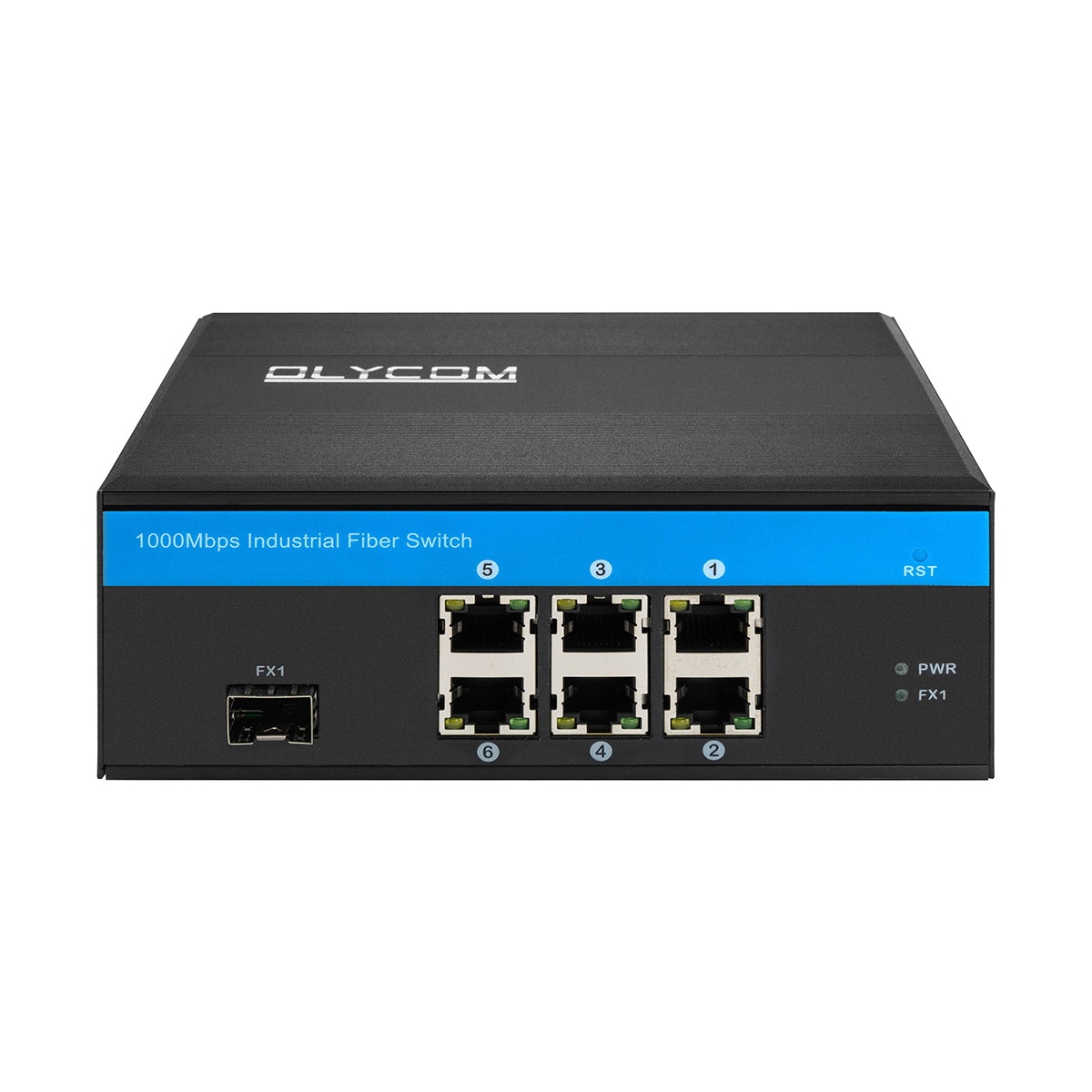
- The Olycom IM-FS160GE is a 7-port industrial Gigabit fiber switch built for the most practical fiber-to-copper conversion need in field deployments: one fiber uplink feeding a dedicated cluster of six local copper endpoints — all from a single rugged DIN-rail unit installed directly inside the equipment enclosure.
- With 1 × 1000Mbps SFP fiber port and 6 × 10/100/1000Mbps RJ45 copper ports, it eliminates the need for a separate downstream copper switch at each fiber termination point, consolidating fiber handoff and local device connectivity into one compact, permanently installed unit.
- A 14Gbps non-blocking switching fabric and 10.416Mpps forwarding rate ensure all six copper ports run at full Gigabit simultaneously without congestion — critical when the connected devices include high-bitrate IP cameras, industrial PCs, or real-time data acquisition systems all transmitting concurrently.
- Certified to NEMA-TS2, EN 50121-4 rail traffic, and IEC 60068 vibration/shock/freefall standards, powered by DC 12–52V wide-range dual input, and rated across -40°C to +75°C in an IP40 corrugated metal housing, the IM-FS160GE is purpose-built for permanent deployment in transportation infrastructure, outdoor cabinets, and industrial automation environments where uptime cannot be compromised.
Key Features
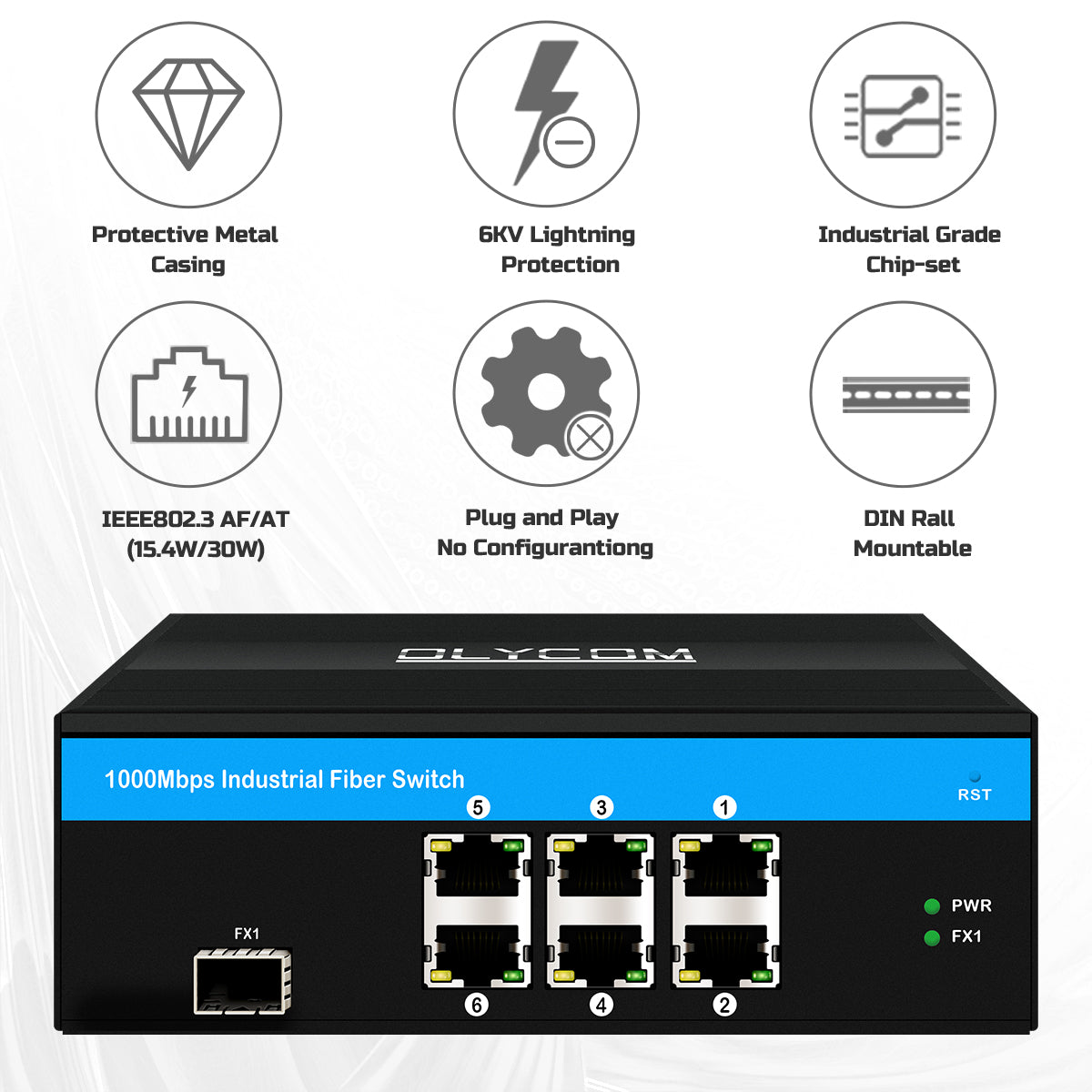
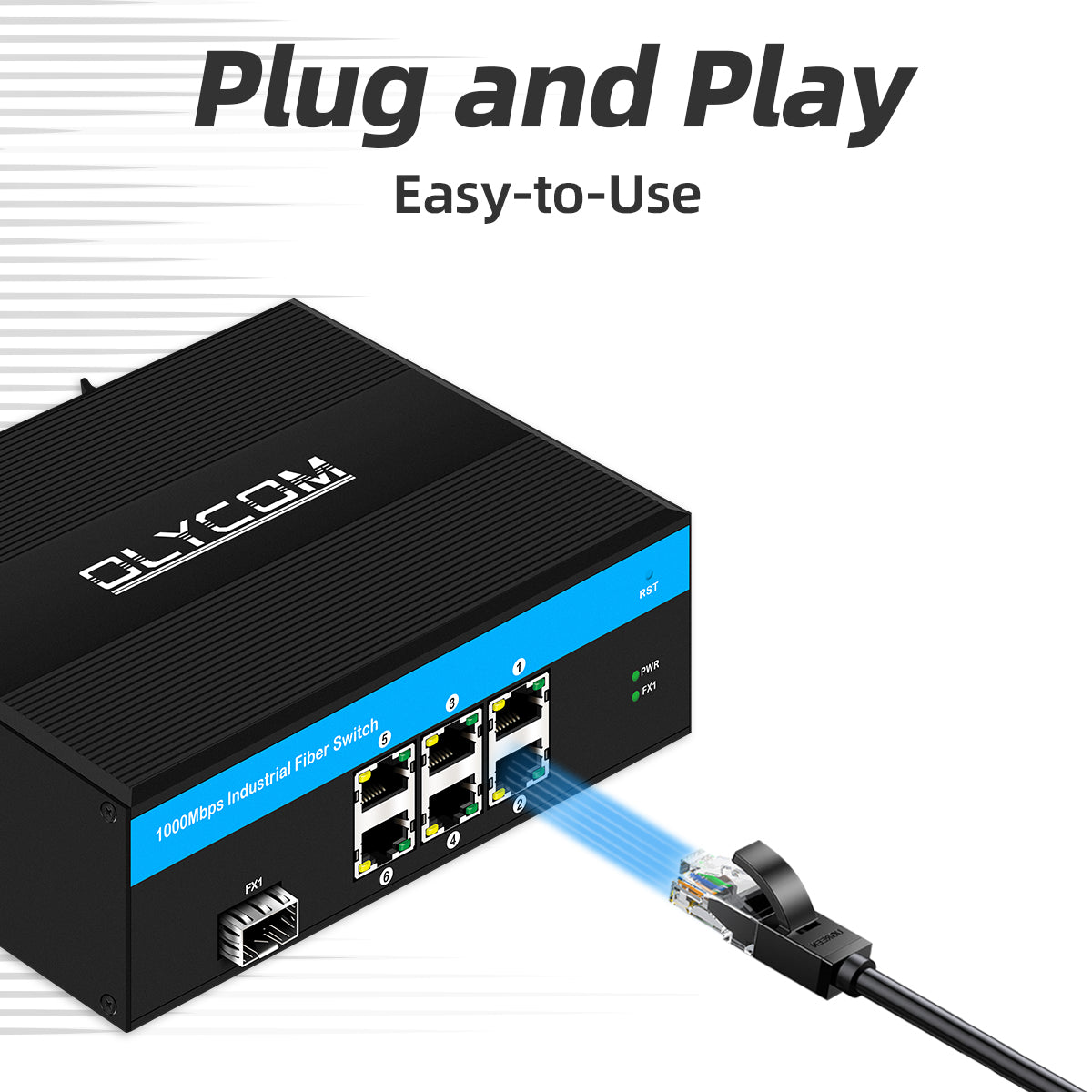
- 1 × 1000Mbps SFP Fiber Uplink — Supports single-mode transceivers (1310/1550nm up to 20km; 1490/1550nm up to 40–120km) and multimode (1310nm up to 2km; 850nm up to 500m); hot-swappable and plug-and-play with no software configuration required
- 6 × 10/100/1000Mbps Auto-Sensing RJ45 Ports — Six Gigabit copper access ports connect a full local device cluster at each fiber termination point; Auto MDI/MDIX on all ports eliminates crossover cable requirements
- 14Gbps Non-Blocking Switching Fabric / 10.416Mpps Forwarding Rate — Wire-speed performance across all seven ports simultaneously; 4K MAC table and 1.75MB packet buffer handle traffic bursts without frame loss
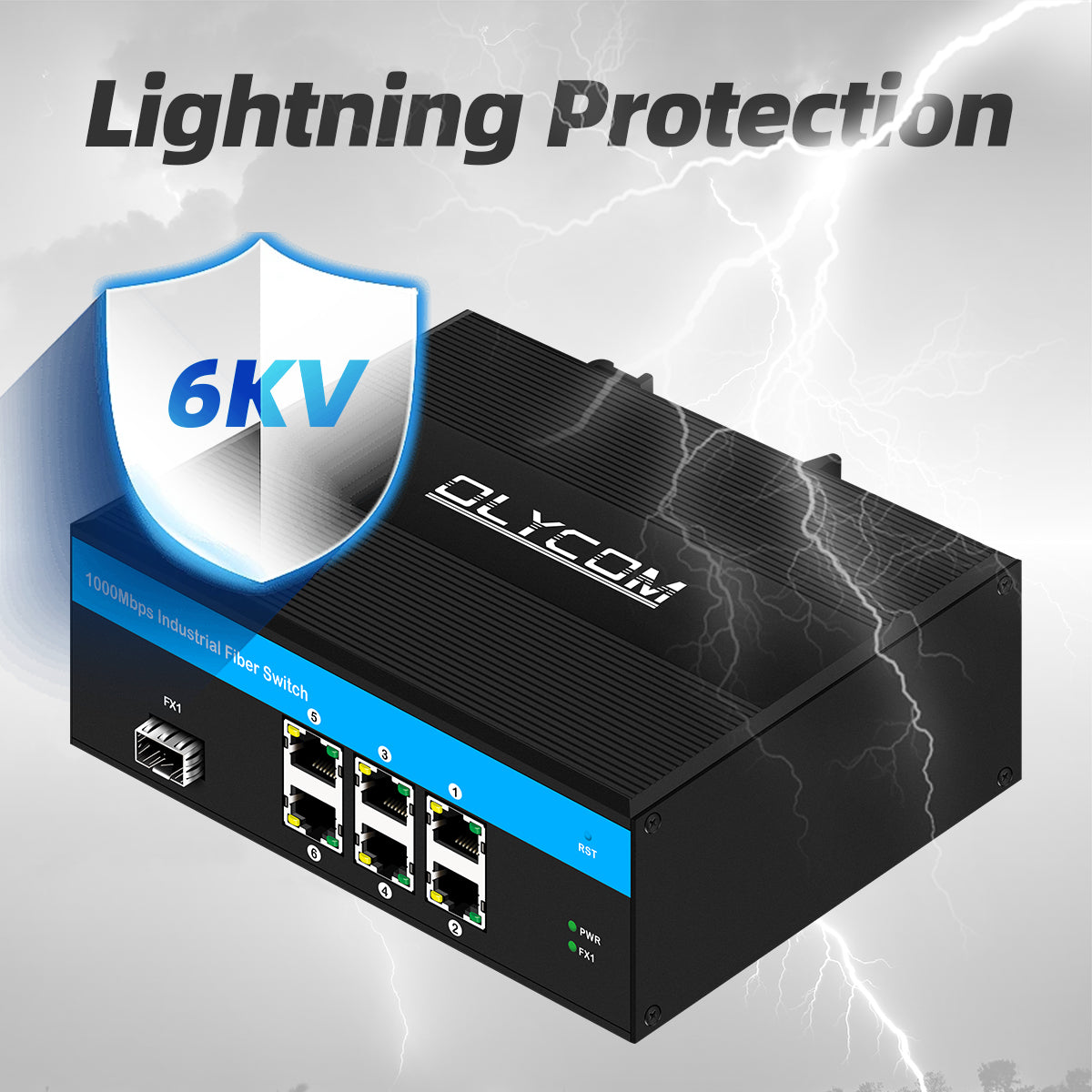
- 6KV Ethernet Surge Protection — Industrial-grade lightning and surge protection on all copper ports; essential for outdoor enclosures, rooftop installations, and exposed field equipment
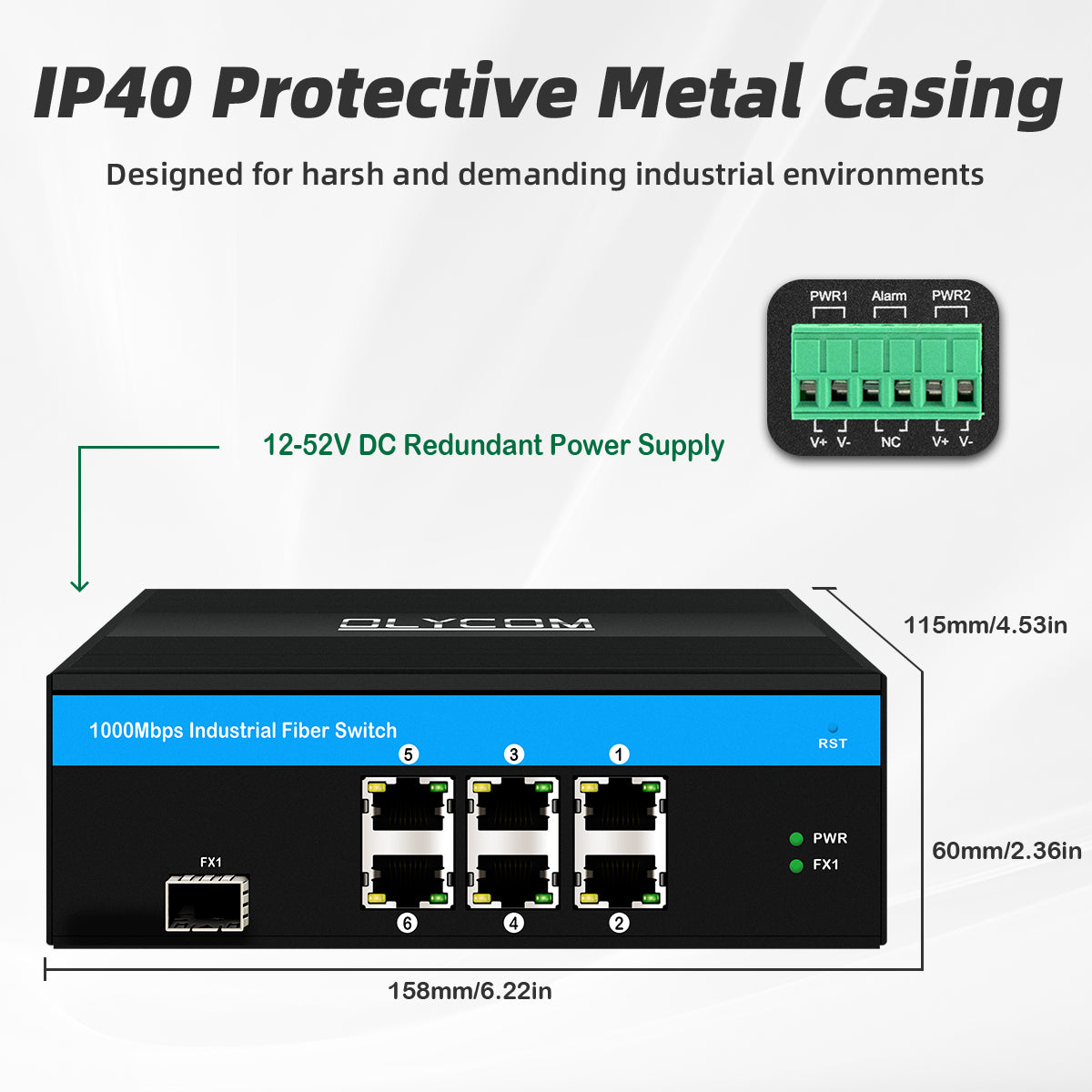
- Wide-Range DC 12–52V Dual Power Input — Accepts 12V, 24V, or 48V DC from plant bus, vehicle battery, or telecom rail; reverse polarity protection prevents damage from miswiring; ≤5W no-load consumption
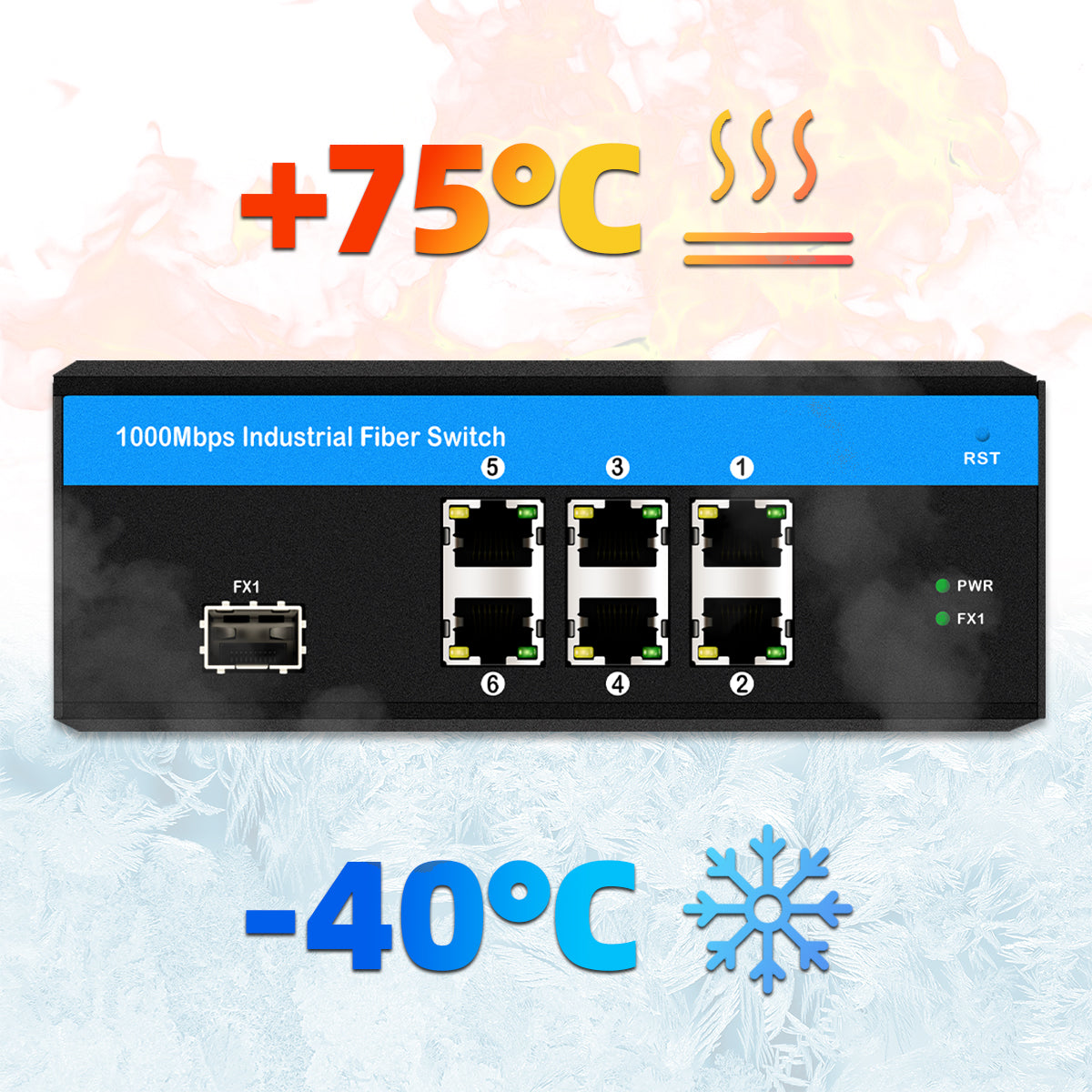
- -40°C to +75°C Operating Temperature — Full-performance cold-start and sustained high-temperature operation with no derating, no fan, and no minimum warm-up period
- NEMA-TS2 Traffic Control Certified — Meets US traffic control system electromagnetic and environmental requirements for roadside and intersection cabinet deployment
- EN 50121-4 Rail Traffic Certified — Qualified for trackside and onboard railway applications under European railway EMC standards
- IEC 60068 Vibration / Shock / Freefall Certified — Mechanically validated for environments subject to continuous vibration, impact events, and transport handling stresses
- EMC to FCC Part 15 Class A & EN 55022 Class A — Industrial EMC classification; EMS immunity to Level 3 across ESD, RS, EFT, Surge, CS, and magnetic field (EN 61000-4-2/3/4/5/6/8)
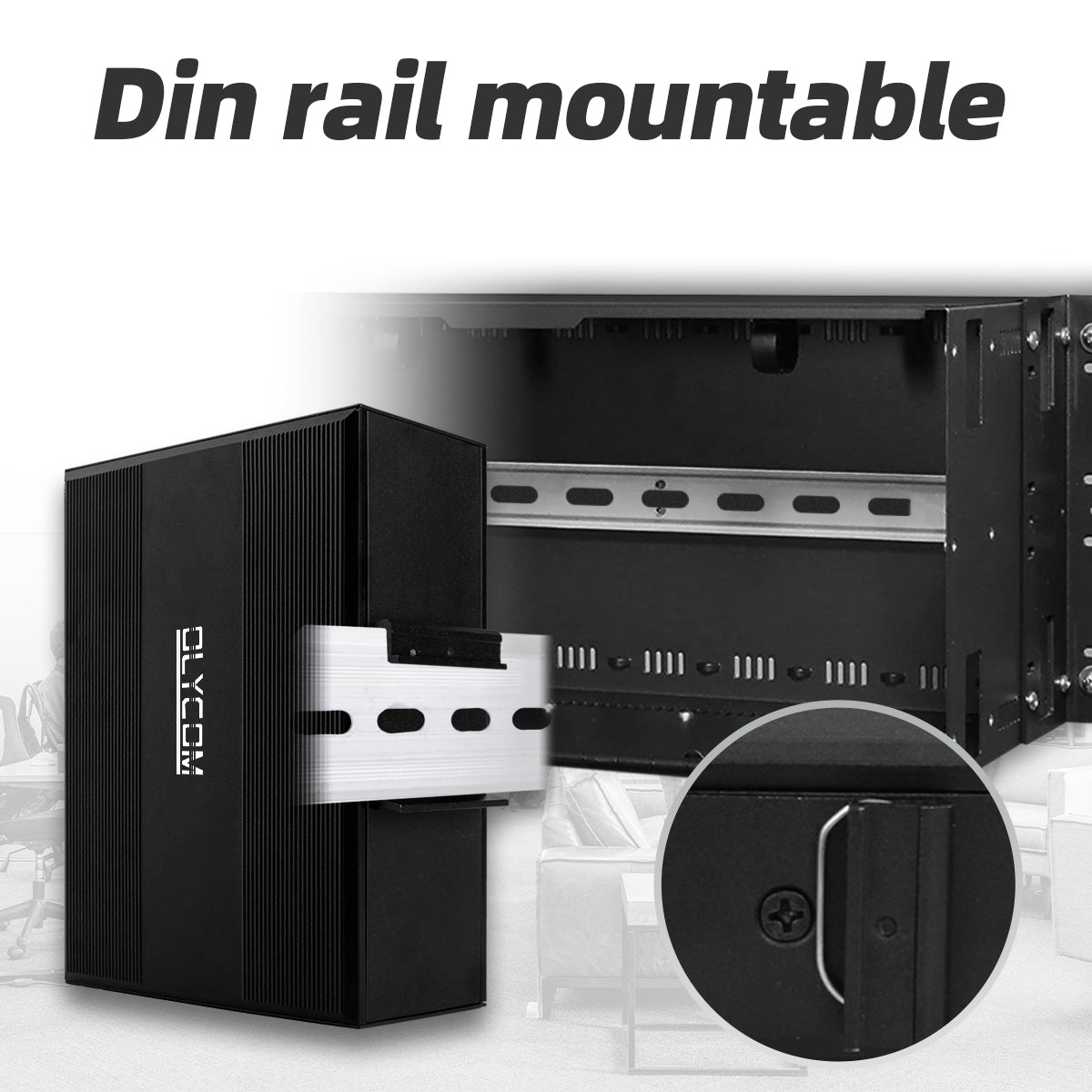
- IP40-Rated Corrugated Metal Housing — Dust-protected, EMI-shielded enclosure; 158 × 115 × 60mm; DIN-rail or wall-mount installation
- CE / LVD EN60950 Safety Certified — 1-year replacement / 3-year repair warranty
Applications
- Intelligent Transportation & Traffic Control — NEMA-TS2 certification makes the IM-FS160GE a natural fit for traffic signal controllers, intersection cameras, and variable message sign networks deployed in roadside cabinets along highways and urban arterials. Six copper ports serve the full complement of devices typically found in a single roadside enclosure — camera, controller, modem, and sensor — from one fiber drop
- Railway Trackside & Station Equipment — EN 50121-4 certification covers deployment in wayside relay rooms, platform equipment racks, and station control panels where continuous vibration from passing trains, traction power interference, and wide ambient temperature swings are constant operating conditions. Six ports support the mix of safety, communications, and passenger information devices typically co-located at each trackside node
- Factory Automation & Process Control — Connects PLCs, HMIs, servo drives, barcode scanners, and machine vision systems to a fiber backbone inside automation cabinets on production lines where motor-drive interference, high ambient temperatures, and mechanical vibration rule out commercial networking equipment
- Outdoor Surveillance & Perimeter Security — Serves as the fiber termination and local switching point for camera clusters at building perimeters, parking structures, and critical infrastructure sites. All six copper ports can simultaneously feed 1080p or 4K IP cameras back to a central NVR over a single fiber run, while 6KV surge protection keeps the switch and cameras online through nearby lightning strikes
- Power Grid & Substation SCADA — Installed inside protection relay panels and RTU cabinets at electrical substations to connect protection devices, meters, and monitoring terminals to fiber-based SCADA networks. Level 3 EMS immunity across all IEC 61000-4 categories meets the demanding electromagnetic environment of high-voltage switchgear rooms
- Water & Environmental Infrastructure — Deployed in pump station control panels, water treatment facility cabinets, and remote environmental monitoring enclosures where the DC power input accepts solar or battery-backed supplies and the wide temperature range covers unheated outdoor installations in all climates
- Mining & Tunnel Communications — IEC 60068 shock and vibration certification supports deployment inside mining equipment enclosures and tunnel infrastructure where blasting events, heavy machinery vibration, and difficult access for maintenance make long-term mechanical reliability essential
Share