

1
/
의
5
OLYCOM
10-Port Full Gigabit Managed PoE Switch 120W 1G SFP Fiber Rack Mounted CE
10-Port Full Gigabit Managed PoE Switch 120W 1G SFP Fiber Rack Mounted CE
정가
$99.99 USD
정가
$109.99 USD
할인가
$99.99 USD
단가
/
단위
픽업 사용 가능 여부를 로드할 수 없습니다.
Introduction
- The Olycom OM288-PSE-GW is where unmanaged PoE switching ends and genuine network intelligence begins.
- As an 8-port fully managed Gigabit PoE switch with Layer 2/Layer 3 capability, it brings enterprise-grade traffic engineering, multi-layer security enforcement, and granular PoE control to a platform that most comparable switches in this port count either omit entirely or implement superficially.
- The distinction matters most in the features that separate a managed switch from a smart switch: SSH-encrypted CLI management, RADIUS/TACACS+/AAA authentication, ACL-based access control, IGMP Snooping with querier, MSTP multi-instance spanning tree, LACP link aggregation, and per-port PoE watchdog with remote reboot capability.
- These are not checkbox features — they are the tools that network engineers reach for when a deployment has security requirements that DIP switches cannot address, redundancy requirements that STP cannot satisfy alone, and operational requirements that demand the ability to restart a frozen camera or AP remotely without dispatching a technician to the site.
- Backed by a 20Gbps non-blocking fabric, 6KV surge and 8KV ESD protection, fanless operation rated to -10°C to +50°C, and dual-stack IPv4/IPv6 management, the OM288-PSE-GW is the right platform when the network being built is one that needs to be monitored, secured, and operated — not just installed and left running.
Key Features
1 Interfaces & Physical
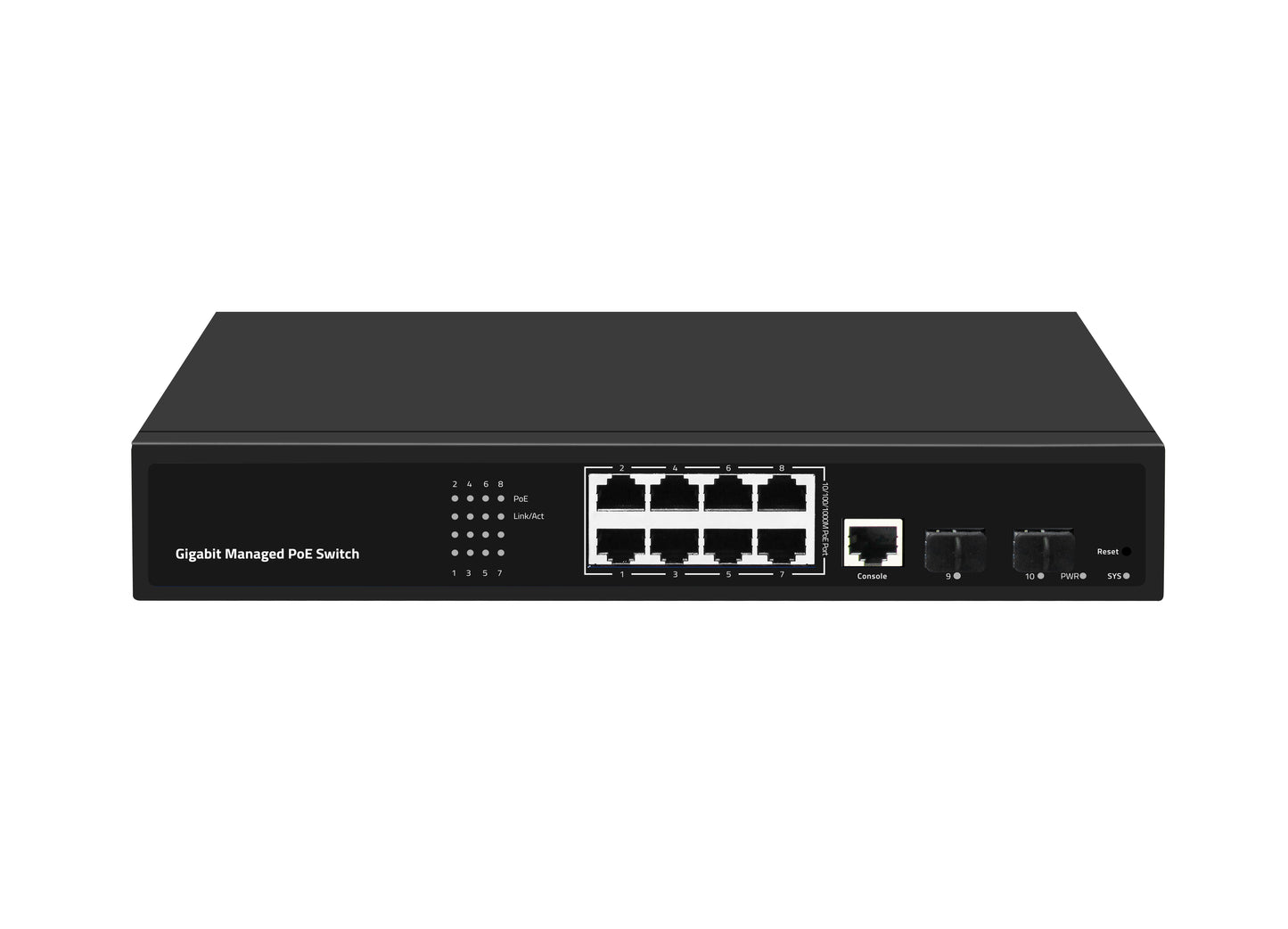
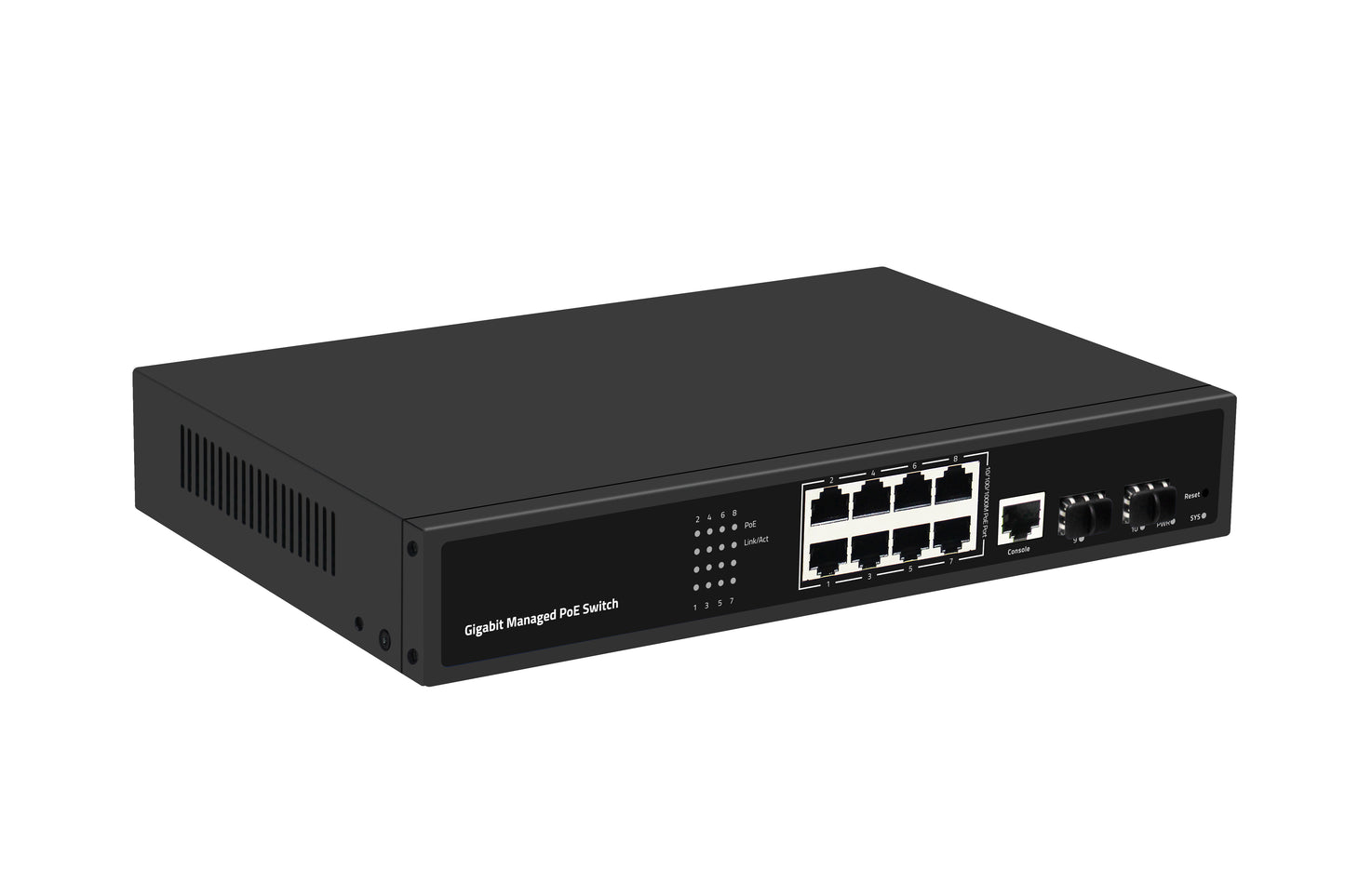
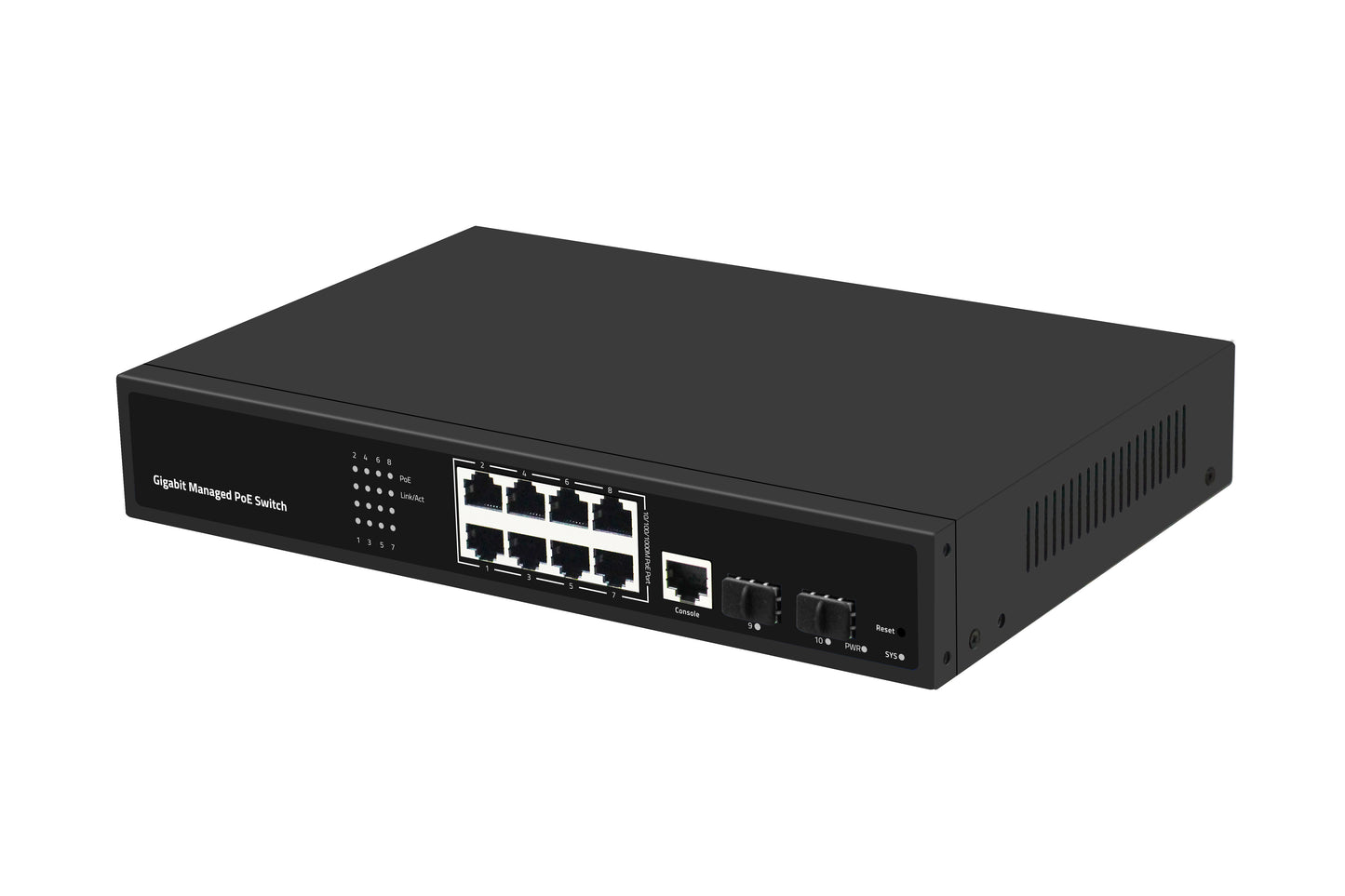
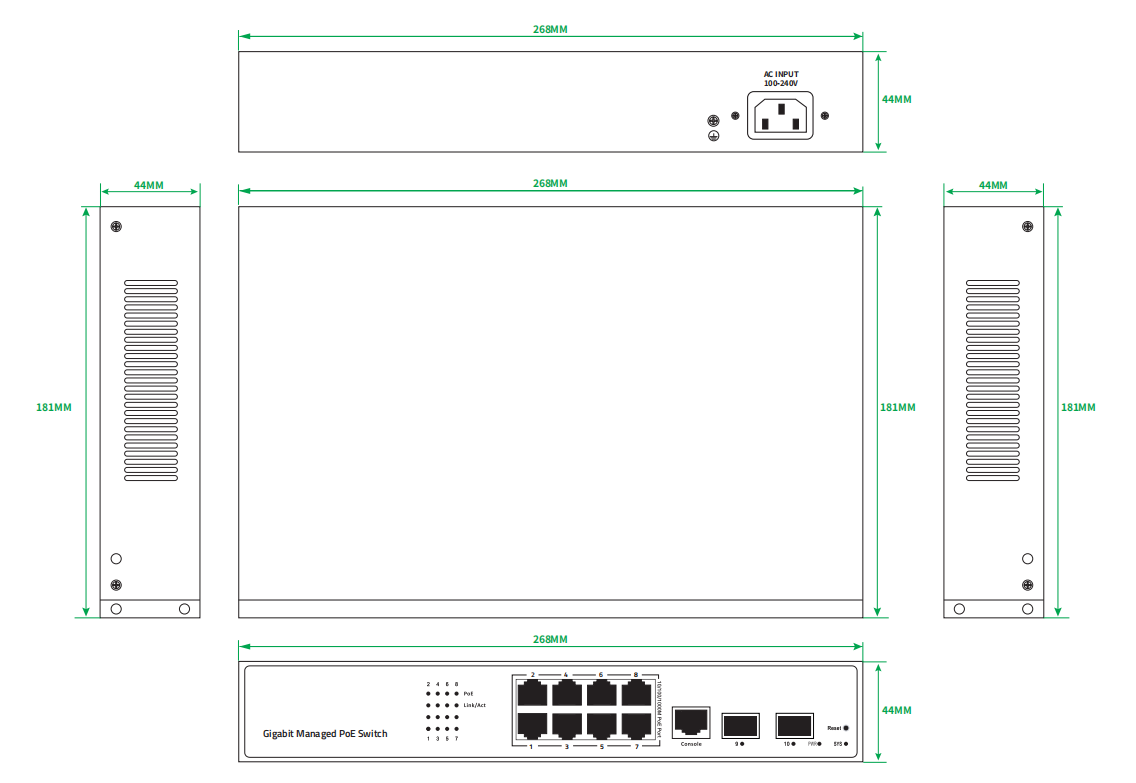
8 × 10/100/1000Mbps PoE Ports — Full Gigabit auto-sensing on all access ports; IEEE 802.3af (15.4W) and 802.3at (30W) per port; 110W total PoE budget; Auto MDI/MDIX; non-PoE devices auto-detected and served data only
2 × Gigabit SFP Uplink Ports — Supports fiber or copper SFP transceivers for flexible backbone connectivity; independent of the 8 PoE access ports so uplink bandwidth is never consumed by access traffic
1 × Console Port — Out-of-band CLI access for initial configuration, recovery, and diagnostics independent of network connectivity
2 Switching Performance
20Gbps Non-Blocking Switching Capacity / 14.88Mpps Forwarding Rate — Wire-speed forwarding across all 10 ports simultaneously; 10KB jumbo frame support handles large video payloads and storage traffic without fragmentation; store-and-forward architecture ensures full frame integrity on every forwarded packet
3 Layer 2 Network Functions
VLAN: IEEE 802.1Q, Port-Based, MAC-Based, Voice VLAN — Flexible traffic segmentation across all deployment scenarios; Voice VLAN automatically identifies and prioritizes VoIP traffic; up to 4094 VLAN IDs supported
QoS: 802.1p / DSCP / Port-Based, 8 Queues per Port — Eight-level hardware traffic queuing with SP, WRR, and SP+WRR scheduling; per-port ingress/egress bandwidth control; storm suppression for broadcast, multicast, and unknown unicast
IGMP/MLD Snooping v1/v2/v3 with Querier — Efficient multicast group management prevents flooding of IP camera streams and IPTV traffic to ports that are not members of the multicast group; MLD Snooping extends the same capability to IPv6 multicast
STP / RSTP / MSTP — Full spanning tree suite; MSTP maps different VLANs to independent spanning tree instances for optimal path utilization and per-VLAN redundancy; RSTP sub-second convergence on topology changes
LACP Link Aggregation (IEEE 802.3ad) — Static and dynamic port bundling across SFP uplinks for combined throughput and path redundancy; a single uplink failure does not interrupt traffic
Port Mirroring — Copies traffic from one or more source ports to a designated mirror port for inline packet analysis, IDS/IPS integration, and network troubleshooting without impacting production traffic
DHCP Server / Relay / Snooping — DHCP server for small network segments; relay for inter-VLAN DHCP forwarding; Snooping filters unauthorized DHCP servers and binds IP-to-MAC-to-port for downstream security enforcement
4 Layer 3 & IPv6
Static Routing, IPv4/IPv6 Dual-Stack — Inter-VLAN routing without a dedicated router for simple multi-subnet environments; static route configuration for predictable, policy-controlled traffic paths
IPv6 Management Suite — SSH, Telnet, SNMP, HTTP/HTTPS, NTP/SNTP, TFTP, ACL, QoS, and ND all available natively over IPv6; future-ready management plane for IPv6-first infrastructure transitions
5 Security
IEEE 802.1X Port Authentication — RADIUS-backed per-port access control; only authenticated devices gain network access regardless of physical port connection
RADIUS / TACACS+ / AAA — Centralized authentication, authorization, and accounting for both device access control and switch management access; integrates with existing enterprise identity infrastructure
ACL: MAC-Based, IP-Based, IPv6-Based — Hardware-accelerated access control lists enforce traffic policy at line rate without performance penalty; supports both ingress and egress ACL application
IP Source Guard — Validates IP packets against DHCP Snooping binding table per port; blocks IP address spoofing at the access layer
Dynamic ARP Inspection (DAI) — Validates ARP packets against trusted bindings; prevents ARP poisoning and man-in-the-middle attacks on the local segment
DoS Defense — Rate-limits and drops protocol-specific attack patterns at hardware level before they consume CPU resources
6 Intelligent PoE Management — The Differentiator
Per-Port PoE Watchdog — Periodically pings each powered device; if a device stops responding, the switch automatically power-cycles that specific port — restarting a frozen camera or AP without any human intervention or site visit
PoE Scheduling — Defines time-based PoE enable/disable policies per port; powers down endpoints during off-hours to reduce energy consumption; automatically restores power on schedule
Per-Port Power Monitoring — Real-time voltage, current, and wattage visibility per PoE port; identifies overloaded endpoints, detects failing PSE/PD interactions, and provides the consumption data needed for accurate power budgeting
Remote PoE Reboot — Manually triggers a power cycle on any individual PoE port from the management interface; the single most-used feature in any deployed surveillance or AP network
7 Management Interfaces
Web GUI, CLI (Console/Telnet/SSH), SNMP v1/v2c/v3, RMON — Full management platform coverage; SSH v2 encrypts all CLI sessions; SNMP v3 with authentication and encryption integrates with enterprise NMS platforms
TFTP/HTTP Firmware Upgrade — In-band firmware update via management network; supports configuration backup and restore
NTP/SNTP, Syslog, Event Log, LLDP — Time synchronization, centralized logging, and topology discovery for full operational visibility
8 Hardware Reliability
6KV Ethernet Surge / 8KV Air ESD / 6KV Contact ESD — Industrial-grade port protection on all interfaces; covers outdoor-adjacent installations and electrically noisy environments
Fanless Natural Convection Cooling — Silent, maintenance-free; no fan replacement schedule; no acoustic noise in sensitive environments
-10°C to +50°C Operating Temperature — Covers unconditioned wiring closets, building distribution rooms, and light industrial environments
CE / FCC / RoHS Certified
Applications
- Managed IP Surveillance Networks — The per-port PoE watchdog is the feature that changes day-to-day operations for surveillance network managers: frozen cameras restart automatically without dispatching a technician, PoE scheduling powers down non-critical cameras during low-risk overnight periods to reduce energy costs, and per-port power monitoring flags cameras drawing abnormal current — often the first indicator of hardware failure — before they go offline. VLAN segmentation isolates camera traffic from corporate data, ACLs enforce which management stations can reach which cameras, and 802.1X prevents unauthorized devices from connecting to surveillance ports
- Enterprise Branch & Campus Wiring Closet — Serves as the managed access layer switch for a small-to-medium office or campus building where IT needs the operational tools — SNMP monitoring, SSH management, RADIUS authentication, and LACP uplink redundancy — that unmanaged or basic smart switches cannot provide. QoS with 8 hardware queues and Voice VLAN ensures VoIP calls are never preempted by background data traffic from the same port, and MSTP maps different department VLANs to independent spanning tree instances so a topology change in one VLAN doesn’t affect others
- Industrial Automation & OT/IT Convergence — Deployed at the boundary between operational technology and corporate IT networks where traffic policy enforcement is non-negotiable: ACLs prevent IT traffic from reaching OT device subnets, IP Source Guard and DAI block spoofing attacks that could compromise PLC communications, and IGMP Snooping contains industrial multicast protocols to the ports that need them. Static routing provides controlled, predictable inter-VLAN connectivity without the complexity and attack surface of dynamic routing protocols at the OT boundary
- Hospitality & Multi-Tenant Property Networks — 802.1X port authentication prevents unauthorized devices from connecting to guest-facing ports, RADIUS integration ties authentication to a central identity system, and VLAN assignment pushes authenticated devices into the correct tenant or guest VLAN automatically. PoE scheduling powers down guest room APs during confirmed checkout windows and powers them back on before check-in, reducing energy consumption across a property with hundreds of rooms without manual intervention per room
- Transportation & Smart Infrastructure Control Points — At transportation management nodes — traffic control centers, railway interlockings, transit authority facilities — where network access is security-sensitive and uptime is operationally critical, the OM288-PSE-GW provides the authentication (802.1X/RADIUS), encrypted management (SSH/HTTPS), audit logging (SNMP/Syslog), and link redundancy (LACP/RSTP) that infrastructure operators’ security policies mandate. PoE watchdog keeps IP cameras and communication devices self-healing, and 6KV surge protection handles the electrical environment of roadside and trackside installations
- Telecom Edge & ISP Access Aggregation — At ISP point-of-presence or edge aggregation nodes where subscribers connect through PoE-powered CPE devices, the OM288-PSE-GW’s combination of DHCP Snooping, IP Source Guard, DAI, and ACL enforcement provides the subscriber isolation and anti-spoofing protection that broadband access networks require at the access layer. SNMP v3 integration allows the ISP’s NMS to monitor per-port utilization, PoE consumption, and link status across the entire access network from a central operations center, and LACP-bonded SFP uplinks provide the redundancy that service-level agreements demand
- Healthcare & Clinical Facility Networks — Enforces strict access control across a clinical environment where medical devices, administrative workstations, and guest Wi-Fi all physically share the same wiring infrastructure: 802.1X authentication assigns each device to the correct VLAN on connection, ACLs prevent cross-segment traffic between clinical and guest VLANs, and per-port power monitoring provides early warning of failing PoE medical device power draws before a device goes offline during patient care. Fanless operation eliminates mechanical noise and vibration in patient areas, and SSH/HTTPS management ensures all remote administration sessions are encrypted
Share