

1
/
の
5
OLYCOM
24 Port 2.5G PoE Switch L3 Managed With 10G Uplink 400W PoE AC Powered Fanless
24 Port 2.5G PoE Switch L3 Managed With 10G Uplink 400W PoE AC Powered Fanless
通常価格
$479.99 USD
通常価格
$499.99 USD
セール価格
$479.99 USD
単価
/
あたり
受取状況を読み込めませんでした
Introduction
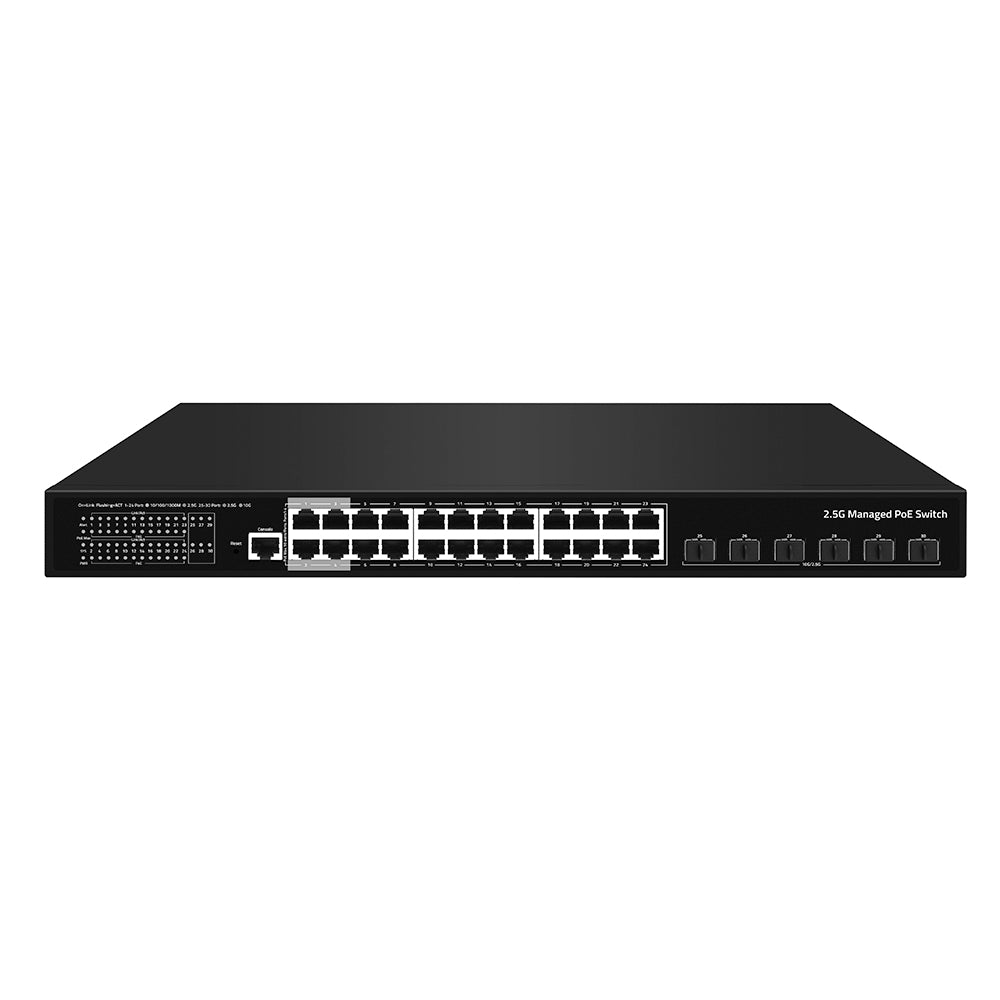
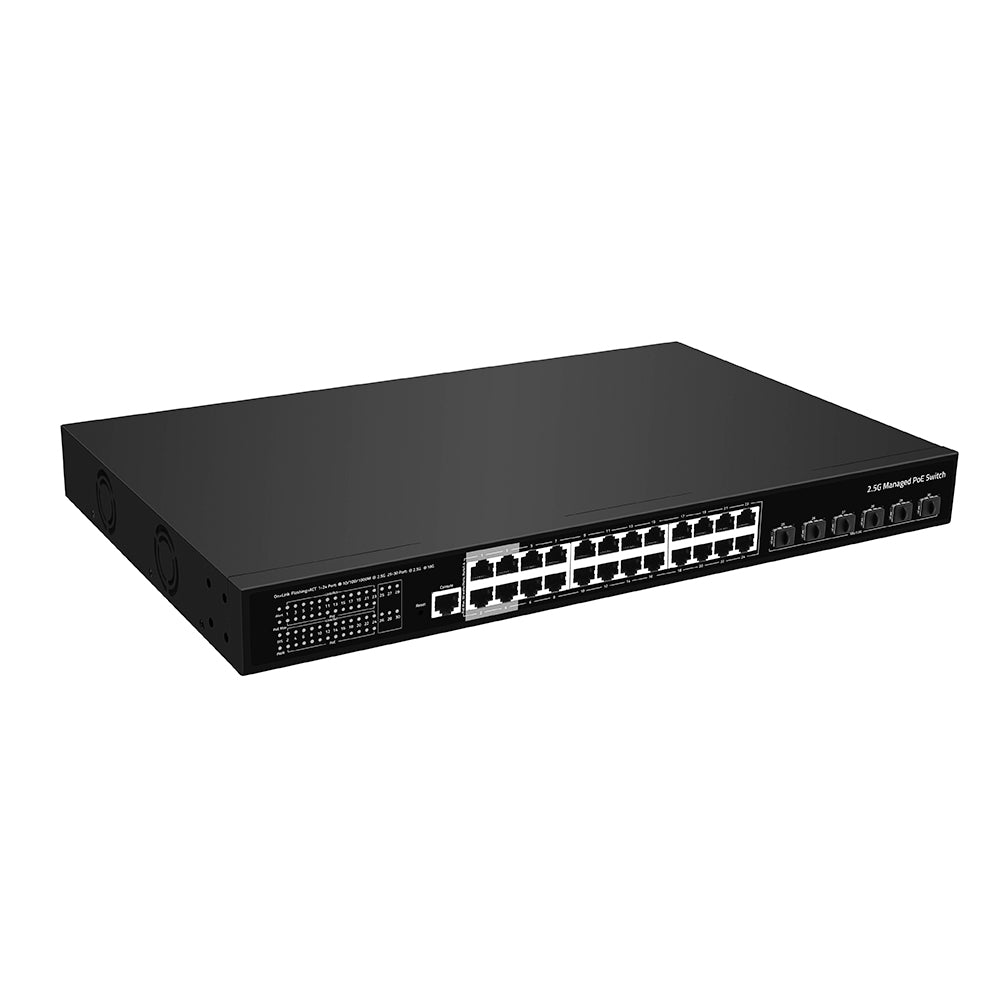
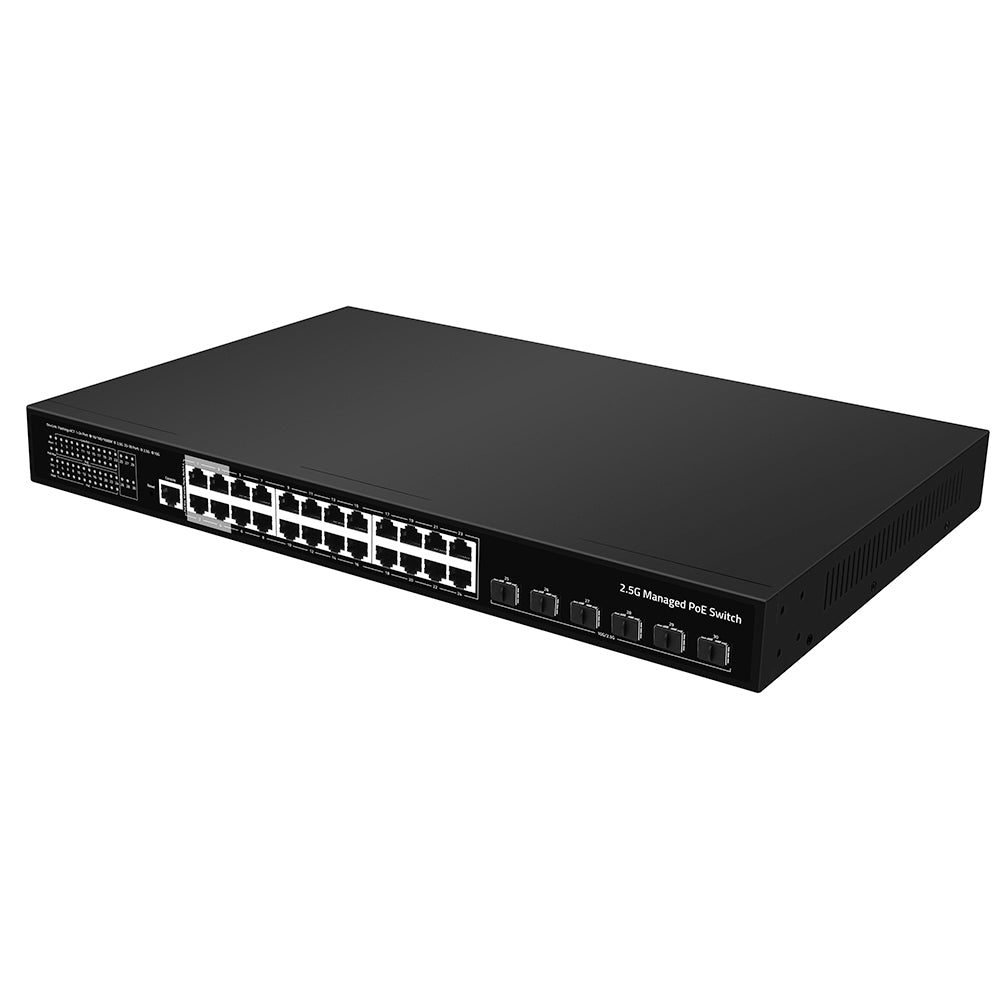
- The Olycom OM6X2424(2)-PSE-GW represents the top of the Olycom managed PoE switch lineup — a platform where three converging demands of modern network infrastructure meet in a single 1U chassis: 2.5G multi-gigabit access, IEEE 802.3bt 90W PoE++, and 6 × 10G SFP+ uplink density.
- The 2.5G access tier is the architectural statement.
- Every one of the 24 access ports negotiates at 100M, 1G, or 2.5G — matching the uplink speed of Wi-Fi 6E APs, 4K/8K IP cameras, and next-generation IoT gateways that have already outgrown Gigabit access but don’t justify a full 10G per-port investment.
- On ports 1–4, IEEE 802.3bt delivers up to 90W per port — enough to power a high-end PTZ camera with a built-in heater, a Wi-Fi 6E AP with a multi-radio configuration, or an industrial gateway with significant onboard computing — from a single Cat6A cable with no power adapter.
- The remaining ports deliver 802.3at (30W), and the 400W total PoE budget is sized to run a fully loaded 24-port deployment without throttling.
- Behind 24 access ports and six 10G uplinks sits a 240Gbps non-blocking fabric running at 178.56Mpps, backed by 512MB DDR memory, 32MB flash, a 32K MAC table, and 16Mbit packet buffer — the memory and processing headroom that separates a platform capable of running OSPF v2, complex VLAN policy, deep ACL rulesets, and SNMP v3 MIBs simultaneously from one that slows down when more than a few features are enabled at once.
- Six 10G SFP+ ports give the network designer enough uplink bandwidth to run LACP-bonded aggregation rings, ERPS-protected 10G topologies, and direct 10G server or storage connections alongside the campus uplinks — all from the same switch.
Key Features
1 Hardware Architecture
24 × 100M/1G/2.5G Multi-Gigabit PoE Ports — Each port auto-negotiates to 100M, 1G, or 2.5G independently; backward compatible with all existing Gigabit and Fast Ethernet infrastructure; 2.5GBASE-T runs on Cat5e up to 100m and Cat6A for full performance — no recabling required for Wi-Fi 6E AP deployments on existing structured cabling
6 × 10G SFP+ Uplink Ports — Six independent 10G slots for fiber or DAC uplinks; supports LACP bonding across multiple slots; provides the uplink bandwidth headroom that 24 × 2.5G access ports require to avoid upstream congestion at the aggregation layer
1 × Console RJ45 + 1 × USB — Out-of-band management console for recovery and initial provisioning; USB for offline firmware upgrade and configuration transfer independent of network state
240Gbps Switching Capacity / 178.56Mpps Forwarding Rate — Non-blocking wire-speed across all 30 ports simultaneously; no internal congestion under full 2.5G load on all access ports plus simultaneous 10G uplink traffic
512MB DDR SDRAM / 32MB Flash / 32K MAC Table / 16Mbit Buffer — The memory specification that defines platform capability ceiling: 32K MAC entries handles large-scale campus and metro deployments without table overflow; 512MB DDR supports deep routing tables, complex ACL rulesets, and full SNMP MIB sets without memory contention between features
10KB Jumbo Frame Support — Eliminates fragmentation for 4K/8K video streams, large NFS/iSCSI storage transfers, and industrial data acquisition payloads
2 PoE++ Power Delivery
Ports 1–4: IEEE 802.3bt, up to 90W per port — Four high-power ports for the endpoints that demand it: Wi-Fi 6E tri-band APs, outdoor PTZ cameras with built-in IR illuminators and heaters, industrial IoT gateways with edge computing modules, and powered enclosures with multiple internal devices. 90W per port on four ports alone accounts for 360W — the platform’s PoE budget is sized accordingly
Ports 5–24: IEEE 802.3af/at, up to 30W per port — Twenty standard PoE+ ports for IP cameras, indoor APs, VoIP phones, and access control devices; per-port auto-detection of 802.3af vs. 802.3at vs. non-PoE; non-PoE devices fully protected
400W Total PoE Budget with Intelligent Thermal Management — Active budget allocation prevents oversubscription; thermal protection monitors junction temperature and adjusts PoE delivery before hardware damage occurs; power priority configuration protects critical ports when total demand approaches ceiling
PoE Watchdog with Per-Port Auto Power-Cycle — Independently monitors every powered endpoint; automatically restarts non-responding devices at the port level without affecting adjacent ports or requiring management intervention; configurable ping interval, failure threshold, and recovery action per port
PoE Scheduling — Per-port weekly power calendar; defines on/off windows for each endpoint independently; automated pre-business-hours power-on and after-hours power-down without scripting or external controllers
Per-Port Real-Time Power Monitoring — Live voltage, current, and wattage per port; historical consumption logging; capacity planning data and early fault detection from abnormal draw patterns
3 Layer 2 Functions
VLAN: 802.1Q, MAC, Protocol, Private, Voice, Surveillance — Up to 4K VLANs — Surveillance VLAN auto-classifies camera traffic by OUI signature without manual port configuration; Private VLAN provides port isolation within a VLAN for ISP subscriber separation; Voice VLAN automatically applies QoS marking to VoIP endpoints on mixed-use ports
QoS: 8 Hardware Queues / DSCP + 802.1p / WRR + Strict + SP+WRR — Per-port 8-level hardware queuing with flexible scheduling; ingress rate limiting and egress shaping per port; storm control for broadcast, multicast, and unknown unicast independently adjustable per port; DSCP remarking for traffic that enters without correct markings
ERPS Ring Protection (ITU-T G.8032), <50ms — Sub-50ms ring failover across 10G SFP+ uplinks; purpose-designed for metro Ethernet rings and campus aggregation rings where a fiber cut cannot cause more than 50ms of service interruption; compatible with MSTP for hybrid topologies
STP / RSTP / MSTP — Independent spanning tree instances per VLAN group under MSTP; topology changes in one VLAN’s instance do not trigger reconvergence in others; BPDU Guard, Root Guard, and Loop Guard available per port
LACP (IEEE 802.3ad) — Static & Dynamic — Bonds multiple 10G SFP+ ports into logical aggregates for combined throughput and redundancy; LACP PDU negotiation confirms partner agreement before activating member links; fast failover on member link failure
IGMP/MLD Snooping v1/v2/v3 + MVR + Querier — MVR (Multicast VLAN Registration) replicates multicast video and IPTV streams from a source VLAN to subscriber VLANs without inter-VLAN routing overhead; IGMP Querier election support for environments without an upstream multicast router; MLD Snooping extends group membership management to IPv6 multicast
DHCP Server / Relay / Snooping / Option 82 / Option 60 — Full DHCP service stack; Option 82 inserts circuit-ID and remote-ID for subscriber identification in ISP deployments; Snooping builds the binding table for IP Source Guard and DAI; Option 60 vendor class filtering for device-type VLAN assignment
UDLD (Unidirectional Link Detection) — Detects fiber links where one direction has failed silently — a failure mode that STP cannot catch — and disables the affected port to prevent black-hole forwarding; critical for 10G fiber ring environments
4 Layer 3 Routing
OSPF v2 — Link-state dynamic routing with automatic neighbor discovery, topology database synchronization, and sub-second convergence; area-based hierarchy for large campus deployments; redistribution between OSPF and static routes for hybrid policy routing
RIP v1/v2 — Distance-vector routing for simpler multi-subnet segments where OSPF computational overhead is unnecessary
IPv4/IPv6 Dual-Stack Static Routing — Full dual-stack forwarding; IPv6 static routes for deterministic inter-VLAN paths; NDP (Neighbor Discovery Protocol) management for IPv6 ARP equivalent; ICMPv6 rate limiting for RS/RA flood protection
ARP Management & Proxy ARP — ARP table size and aging control; Proxy ARP for routed inter-VLAN transparency where clients are not configured with a default gateway
5 Security
802.1X + RADIUS + TACACS+ + AAA — Port-level device authentication before any network access is granted; RADIUS dynamically assigns authenticated devices to their correct VLAN and QoS policy; TACACS+ provides per-command authorization and accounting for switch management access with full audit trail; AAA framework separates authentication, authorization, and accounting planes independently
ACL: MAC / IPv4 / IPv6 — Ingress & Egress, Time-Based — Hardware ACL at line rate; both ingress and egress application per port; time-based ACL activation schedules policy changes without manual intervention; ACL logging for compliance audit trails
IP Source Guard — Validates source IP and MAC of every packet against the DHCP Snooping binding table at hardware speed; drops packets that don’t match — effectively preventing IP spoofing at the access port level before it reaches the routing layer
Dynamic ARP Inspection (DAI) — Validates ARP packets against trusted DHCP Snooping bindings; drops gratuitous ARPs and unsolicited ARP replies from untrusted ports; prevents ARP cache poisoning across all VLANs simultaneously
DoS Defense — Hardware rate-limits SYN floods, ICMP floods, UDP floods, and malformed packet attacks before they consume CPU resources; configurable per attack type with independent thresholds
6 Management & Diagnostics
Web GUI, SSHv2, Telnet, CLI, SNMP v1/v2c/v3, RMON Groups 1/2/3/9 — Full enterprise management stack; RMON Group 9 (Events) enables threshold-based alerts without constant NMS polling; HTTPS and SSHv2 encrypt all remote management sessions
LLDP / LLDP-MED — Automatic discovery and inventory of connected VoIP phones, APs, and cameras; LLDP-MED pushes network policy (VLAN, CoS, DSCP) to endpoints automatically on connection — eliminating manual per-device configuration for large VoIP and surveillance deployments
Dual Firmware Image — Maintains two independent firmware images; failed upgrade activates the previous known-good image automatically — zero-risk firmware updates in production environments
USB Configuration Backup / Restore / Firmware Upgrade — Complete switch configuration exported to or restored from USB without network access; a replacement unit is fully configured in minutes from a USB stick
Diagnostics: Ping, Traceroute, Copper TDR Test, Port Mirror, Syslog — TDR (Time Domain Reflectometry) locates cable faults and measures cable length from the switch CLI without external test equipment; Syslog exports event data to a central logging server for SIEM integration
Applications
- Wi-Fi 6E Campus Access Distribution — The 2.5G access tier is the direct answer to Wi-Fi 6E’s physical layer speed: Wi-Fi 6E APs consistently exceed Gigabit throughput under real-world multi-client loads, and a Gigabit switch port becomes the bottleneck before the radio does. The OM6X2424(2)-PSE-GW eliminates that bottleneck on all 24 ports simultaneously — and the 802.3bt 90W capability on ports 1–4 powers the highest-density tri-band APs that require more than 30W without a separate power injector. Six 10G SFP+ uplinks aggregate the floor or building’s traffic to the campus core at speeds that won’t be saturated even under full 2.5G load across all 24 ports
- 4K/8K Surveillance Aggregation Node — High-resolution IP cameras generating 4K or 8K streams produce data rates that strain Gigabit switch ports under encoding load spikes. The 2.5G access ports provide the headroom those streams need, the 10KB jumbo frame support prevents fragmentation overhead, and IGMP Snooping with MVR replicates streams to authorized monitoring stations without flooding the access network. Surveillance VLAN auto-classifies camera traffic on connection, PoE watchdog self-heals frozen cameras, and the 400W budget — with 90W available on ports 1–4 for PTZ cameras with integrated heaters — handles the most power-demanding outdoor surveillance deployments without supplementary power infrastructure
- Metro Ethernet Aggregation & OLT Uplink — At ISP metropolitan aggregation points collecting traffic from OLTs, DSLAMs, and downstream access switches, the six 10G SFP+ ports provide the uplink density for ERPS-protected 10G aggregation rings, LACP-bonded uplinks to the metro core, and direct 10G OLT connections simultaneously. DHCP Option 82 enables per-subscriber circuit identification for upstream RADIUS billing, MVR replicates IPTV multicast without flooding subscriber VLANs, and Private VLAN enforces subscriber-to-subscriber isolation at the access layer. OSPF v2 dynamic routing converges the aggregation topology after any ring failure within ERPS’s 50ms window — meeting the service availability SLA that ISPs contractually commit to
- Enterprise Data Center Access & Server Edge — Six 10G SFP+ ports connect directly to server NICs, NAS controllers, and hypervisor hosts requiring 10G access, while 24 × 2.5G PoE ports serve out-of-band management interfaces, IP KVM switches, and infrastructure monitoring devices from the same chassis. LACP bonds multiple 10G ports to high-throughput storage arrays, OSPF routes between server VLANs and management VLANs, and IP Source Guard with DAI prevents any server from spoofing another’s IP or ARP cache — a critical security control in multi-tenant or shared hosting environments where server-to-server trust cannot be assumed
- Industrial IoT Gateway Distribution — Industrial IoT gateways — edge computing nodes running AI inference, protocol translation, or real-time analytics — increasingly ship with 2.5G or faster network interfaces and power requirements that exceed 802.3at’s 30W ceiling. The OM6X2424(2)-PSE-GW’s 802.3bt 90W ports power these gateways directly from the switch while delivering 2.5G data connectivity, and OSPF routing separates IoT traffic from corporate IT at the distribution layer with ACL policy enforcing which OT subnets can reach which IT resources. UDLD protects the 10G fiber uplinks from the unidirectional failures that industrial vibration environments can cause in fiber connectors without triggering STP reconvergence
- Smart City Multi-Service Distribution Hub — At a city-level distribution point aggregating traffic from traffic cameras, public Wi-Fi APs, environmental sensors, smart lighting controllers, and emergency communications equipment, the OM6X2424(2)-PSE-GW applies VLAN segmentation to keep each service domain isolated, QoS strict priority to ensure emergency communications are never preempted, and RADIUS-integrated 802.1X to authenticate every device connecting to any port. PoE scheduling manages smart lighting power delivery on a time-of-day basis without external controllers, and the 400W budget supports the mixed power demands of a heterogeneous device fleet — from 5W sensors to 60W outdoor APs — without power priority conflicts
Share